Summary: software with email marketing integrated AI automates personalisation, segmentation, and campaign sending using predictive models. In 2026, the most advanced platforms generate subject lines, adapt content by behaviour, and optimise send times without manual intervention.
What is integrated AI email marketing software
Integrated AI email marketing software is a platform that incorporates machine learning models directly into the workflow of creating, segmenting, and sending email campaigns. Unlike traditional tools, where the professional manually defines each automation rule, these platforms analyse the historical behaviour of each contact and adjust content, subject line, send time, and frequency in real-time. According to data from McKinsey & Company published in their 2023 productivity report, AI-powered personalisation can increase marketing-derived revenue by 10% to 15%. In the context of email marketing, this translates into campaigns that adapt to the subscriber's lifecycle without needing to create dozens of manual variants.
The core difference between an AI-powered tool and one without isn't cosmetic. A traditional platform executes the rule you program: 'if the user opens the email, wait 2 days and send the next one.' A platform with smart email automation learns that a specific user opens emails on Tuesdays at 8:30 AM, responds better to direct question subject lines, and that their conversion probability drops if they receive more than two emails in a week. This continuous inference capability is what turns the tool into a strategic asset.
By 2026, the market no longer distinguishes between 'AI-powered platforms' as a premium category and 'non-AI platforms' as standard. AI is the baseline.
The competitive difference lies in the depth of that integration: whether AI only acts on the email subject line or if it permeates the entire chain, from list building to churn analysis.

To understand which platform to choose, you first need to break down which AI features are genuinely useful and which are just product marketing.
Which AI features truly matter in an email platform?
By 2026, AI-powered email marketing platforms offer a set of capabilities that go far beyond automatic text generation. The features that generate a measurable impact on business metrics are five: send time optimisation, subject line generation and testing, predictive behavioural segmentation, dynamic content personalisation, and churn risk detection. These capabilities are not equivalent across platforms: some implement them at a global account level (a single model for all platform users), while others apply them at an audience-specific level, which produces more precise results for lists with sufficient history.
Send time optimisation
Predictive send time optimisation analyses each contact's open history and predicts the time slot and day of the week when they are most likely to open and click. Instead of sending the entire campaign at 10:00 AM on Tuesday because 'industry benchmarks say so', the platform scales the send over several hours or days so that each subscriber receives the email in their personal optimal window.
This feature seems simple but has a direct impact on open rates. When sending is personalised per contact rather than in batches, inbox competition is reduced during mass peak hours.
The benefit isn't just opens: an email opened at the right time is more likely to generate a click because the user is in a context of higher attention.
AI-powered subject line generation and testing
Language models integrated into platforms like those competing in this segment generate subject line variants based on the email content and audience profile.
Beyond generation, the valuable feature is automated multivariate testing: AI launches several subject line versions to a small sample, measures performance in real-time, and distributes the remaining volume towards the winning variant before the professional has even reviewed the initial results.
This transforms email A/B testing into a continuous and autonomous process, not a one-off experiment requiring manual setup each time.
Dynamic Content Personalisation
Dynamic personalisation allows different content blocks to be displayed within the same email based on the segment each contact belongs to. A user who has visited product category X sees that block; another who is in a re-engagement phase sees a different offer.
AI decides which block to show to whom based on behavioural history, not a static segment rule.
This capability has the greatest impact on email marketing conversion rates because relevant content reduces friction between opening and action.
Churn risk detection
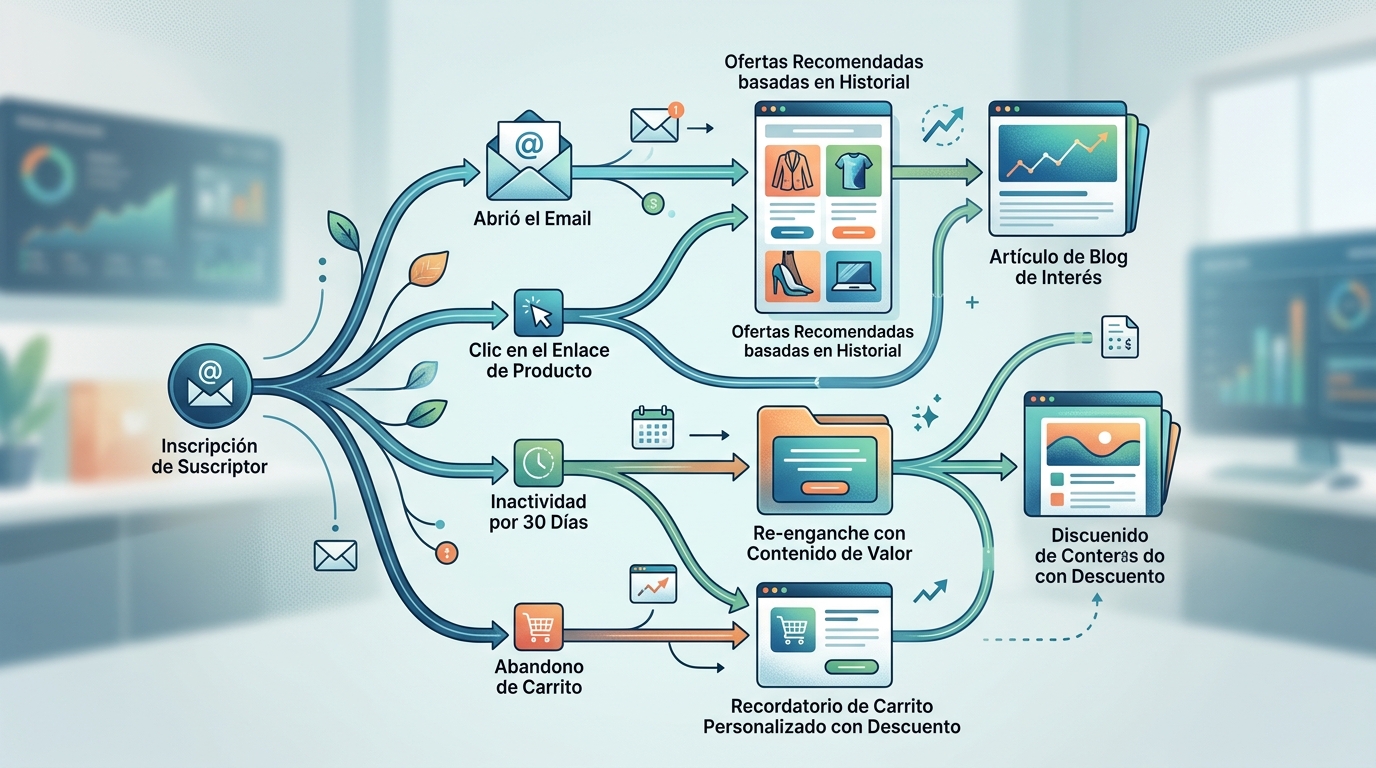
A less visible but highly valuable feature is the predictive detection of subscribers at risk of unsubscribing or becoming inactive.
AI identifies disengagement patterns (drop in open rates, lack of clicks, change in website visit frequency) and automatically triggers re-engagement flows before the subscriber decides to unsubscribe.
Reducing unsubscribe rates isn't just a vanity metric: a list with a high unsubscribe rate negatively impacts the sender domain's reputation and consequently, the deliverability of all campaigns.
What are the best AI email marketing platforms in 2026?
The market for AI email marketing platforms in 2026 is dominated by global players who have integrated generative and predictive AI capabilities into their core offerings. When comparing options, the most important criteria for B2B and B2C marketing teams are: depth of AI integration, segmentation capabilities, CRM and ecommerce integrations, pricing per contact volume, and quality of Spanish language support.
The following table outlines the most relevant evaluation criteria for choosing between platforms. The values are qualitative because prices and features change frequently, and each tool has different plans based on volume:
| Criterion | Weight in Decision | What to Evaluate |
|---|---|---|
| AI in Segmentation | High | Predictive segmentation vs. manual rules |
| Send Optimisation | High | Per contact vs. per global campaign |
| Content Generation | Medium | Quality of Spanish-generated copy |
| CRM/Ecommerce Integrations | High | Native APIs vs. Zapier connectors |
| Deliverability | Critical | IP reputation, DKIM/SPF authentication |
| Spanish Support | Medium-high | Chat, tickets, documentation in Spanish |
| Scalable Pricing | High | Cost per 10,000 / 100,000 / 500,000 contacts |
Leading platforms in this segment in 2026 include global names such as Klaviyo (ecommerce-focused), HubSpot (CRM-centric with integrated email), ActiveCampaign (advanced automation), Brevo (formerly Sendinblue, strong in the European market and with good Spanish language coverage), and Mailchimp (which has significantly evolved its AI capabilities).
Each has distinct strengths, and none is a universal best option: the choice depends on list size, industry, integration level with other tools, and available budget.
For teams working with Boomatik or looking to integrate their marketing stack with a smart email automation solution, native integrations with the primary platform are often the decisive factor, even outweighing price.
How does smart email campaign automation work in practice?
Smart email campaign automation isn't just a sequence of emails scheduled with conditional rules. It's a system where the AI model continuously updates flow branching decisions based on the contact's recent behaviour, without the marketer having to manually redefine the rules. In practice, this means the same flow can behave differently for two contacts with distinct profiles, even if both entered via the same trigger. According to Salesforce data published in their State of Marketing 2024 report, 71% of high-performing marketing professionals already use AI-powered automation to personalise the customer journey.
Smart Welcome Flows
The welcome flow is the first post-subscription touchpoint and where AI can make the biggest short-term difference. Instead of sending the same three-email sequence to all new subscribers, an AI email marketing platform adapts the cadence and content based on the acquisition source (ad from social media, content download, event registration), behaviour in the first emails (open, click, site visit), and firmographic profile if it's a B2B environment.
A new subscriber who opens the first email, clicks the main link, and visits the pricing page within the next two hours is a qualified lead deserving of an accelerated flow branch.
Another who doesn't open within 72 hours needs a different second subject line or a resend with content variation. AI manages these bifurcations automatically.
Cart Recovery and Reactivation Flows
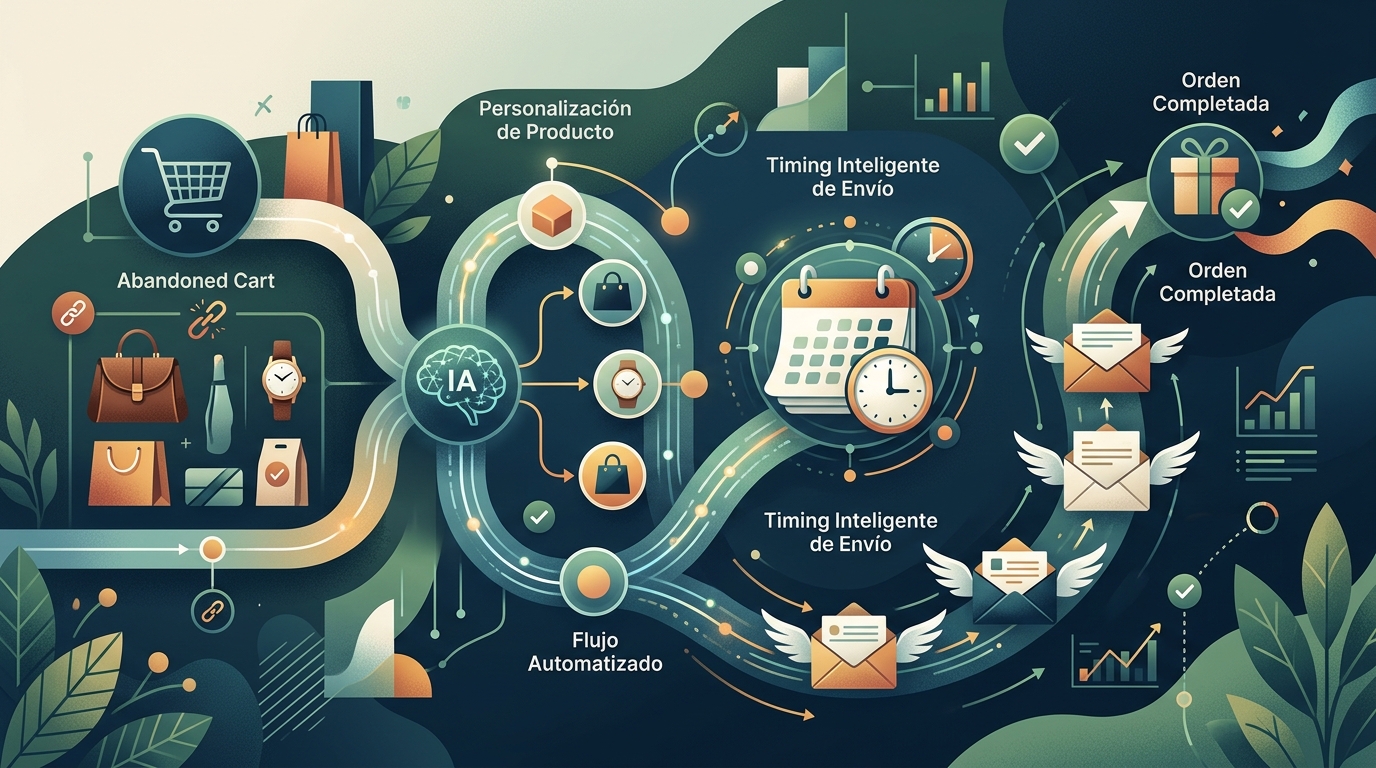
In ecommerce, abandoned cart recovery email flows are one of the use cases with the highest direct return. AI improves these flows in two ways: first, it decides whether to launch the recovery email immediately or wait (some users return on their own within the first few hours); second, it personalises the email content with the exact abandoned products, updated prices, and complementary recommendations based on purchase history.
Reactivation flows for inactive subscribers follow a similar logic: AI identifies the inactive segment, generates subject line variants designed to capture attention after a period of silence, and applies a sunset logic (removal of unresponsive inactives) to protect domain reputation.
CRM and Behavioural Data Integration
Smart automation is only as good as the data that feeds it. CRM-integrated email marketing platforms that synchronise interaction history, customer lifetime value (LTV), and purchase cycle status in real-time produce much more precise flows than those that only work with email behavioural data.
This integration is particularly relevant for B2B companies where the sales cycle is long and email is just one of multiple touchpoints.
The more complete the data profile available to the AI model, the more precise the personalisation and the more relevant the message at each stage of the conversion funnel.
Predictive personalisation and advanced segmentation
Predictive personalisation in email marketing uses propensity models to anticipate what action each contact will take before they take it. These models analyse the contact's behavioural history (opens, clicks, site visits, purchases, downloads) and calculate a probability score for various future events: likelihood of purchase in the next 30 days, likelihood of unsubscribe in the next 14 days, likelihood of responding to an upsell offer. According to Epsilon's 2023 customer personalisation report, 80% of consumers state they are more likely to purchase from a brand that offers personalised experiences. Email personalisation is one of the channels where this preference can be acted upon most directly and measurably.
Behavioural Segmentation vs. Demographic Segmentation
Traditional segmentation groups contacts by static attributes: industry, company size, geographical location, age. This data is useful for defining initial audiences but has a clear limitation: it doesn't reflect the purchase timing or the contact's current level of interest.
Behavioural segmentation in email groups contacts based on their recent actions and interaction patterns. A contact who has visited the pricing page three times in the last week is at a very different decision point than one who visited that same page six months ago. AI detects these intent signals and adjusts communication accordingly.
The most advanced platforms combine both dimensions: firmographic or demographic attributes as a base context, and recent behaviour as an intent signal. This combination produces dynamic segments that automatically change as the contact progresses or regresses in their lifecycle.
AI-powered Lead Scoring
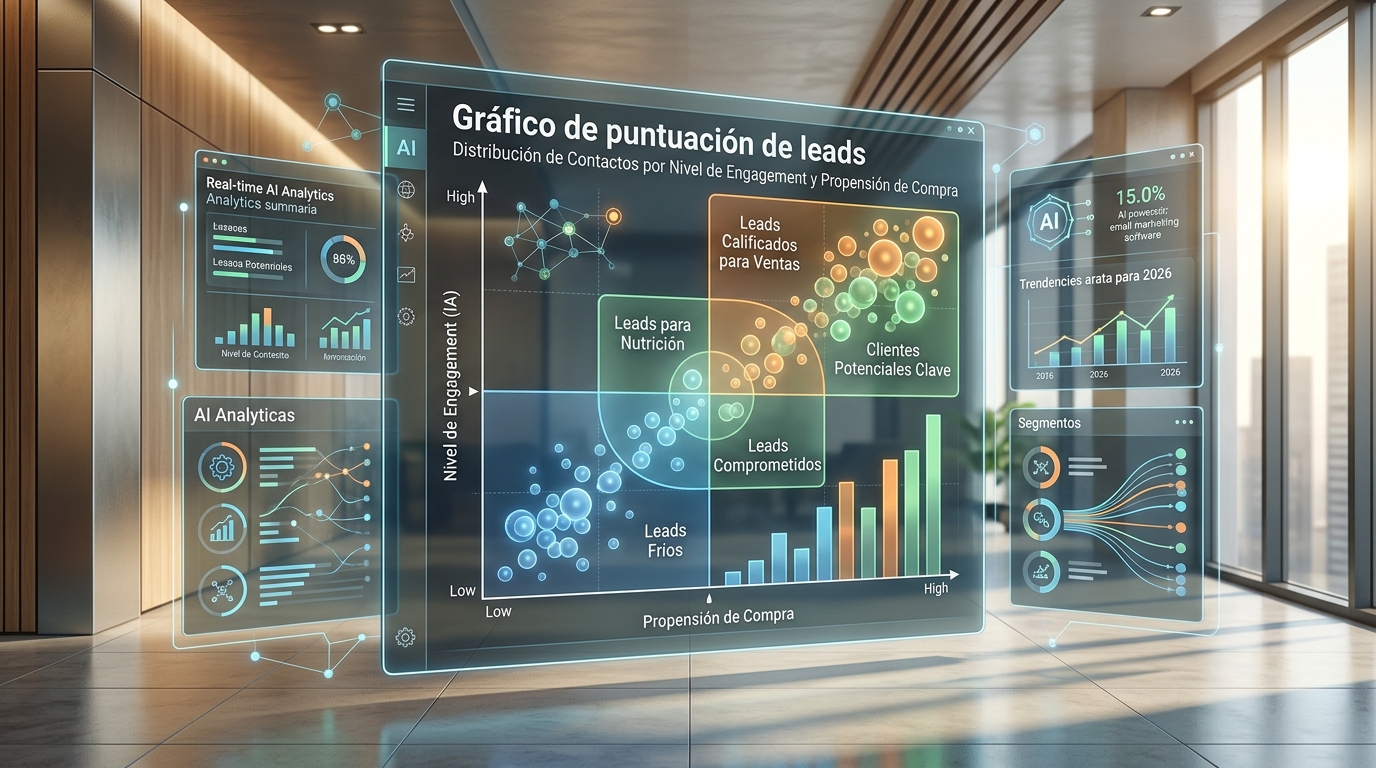
Marketing automation for small business lead scoring automated with AI assigns a numerical score to each contact based on their proximity to the ideal customer profile and their recent engagement level. Unlike manual lead scoring, where the marketing team defines fixed points for each action (open = 2 points, click = 5 points, pricing page visit = 10 points), AI scoring learns which combinations of actions best predict actual conversion and automatically adjusts the weights.
This capability is particularly valuable in B2B environments where the sales team needs to prioritise lead follow-up.
An accurate scoring system reduces the time sales spends on unqualified leads and increases the close rate by focusing efforts on contacts with the highest probability of conversion.
What key metrics allow you to evaluate performance with AI in email marketing?
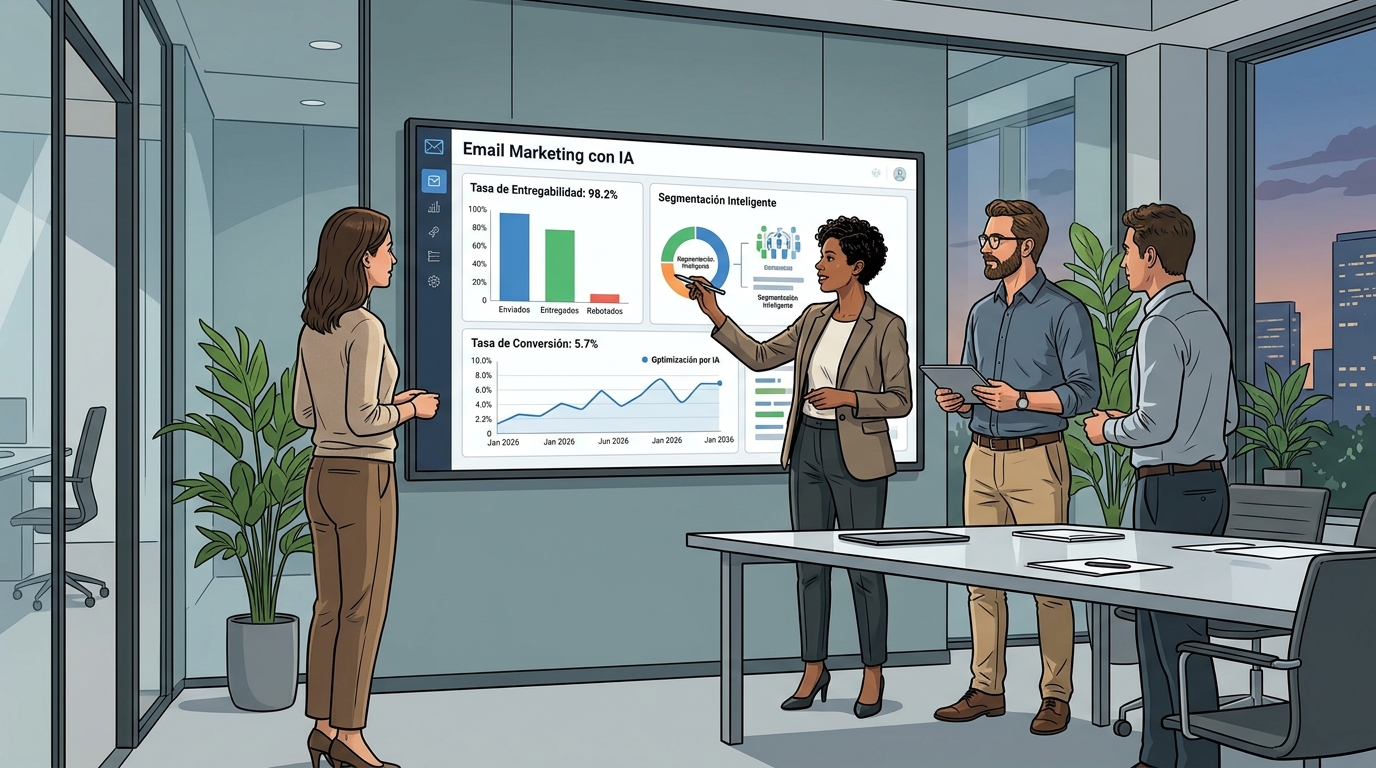
Evaluating the performance of an AI-powered email marketing campaign requires looking beyond superficial open and click metrics. These metrics are indicators of attention, but not business outcomes. The metrics that truly matter to justify investment in an AI platform are those that connect email behaviour with measurable business results. Email-attributed conversion rate (sales, qualified leads, gated content downloads), revenue per email sent, campaign cost per conversion, and return on investment in the tool are the four metrics any team should track monthly.
Open Rate and its Post-2021 Context
Since Apple introduced Mail Privacy Protection in iOS 15 in 2021, the email open rate has lost reliability as an individual metric. Platforms that preload images in the background generate recorded opens that don't correspond to an actual user open. This doesn't mean the metric is useless, but rather that it must be interpreted in context and combined with other signals.
A good practice is to use the open rate as a trend indicator (up or down compared to the previous period) and complement it with the click-to-open rate (CTOR), which measures what percentage of those who actually open the email click. This metric is more robust because it requires an active user action.
Deliverability and Sender Reputation
Email deliverability is the foundation upon which all other metrics rest. An email not delivered to the inbox cannot be opened, clicked, or converted. AI platforms monitor sender domain reputation signals in real-time: hard bounce rate, spam complaint rate, scores on major blacklists, and correct authentication of DKIM, SPF, and DMARC protocols.
A platform that automatically detects sender reputation degradation and adjusts sending volume to protect deliverability has a direct impact on the performance of all campaigns, not just those currently running.
What are the most common mistakes when choosing AI email marketing software?
Choosing integrated AI email marketing software based solely on price or brand name is the most common mistake marketing teams make when purchasing. The second most frequent mistake is overestimating AI's capabilities without sufficient data to feed it: a predictive model working with a list of 500 contacts with no behavioural history cannot produce significantly better results than a well-configured manual automation.
Choosing the tool before defining the use case
Before evaluating any platform, the team must be clear about what they need it for. Relevant questions include: is the main goal to increase ecommerce sales, nurture B2B leads, reduce unsubscribe rates, or improve deliverability?
Each of these objectives favours a different type of platform.
An ecommerce team with a broad catalogue and high purchase frequency benefits most from a platform strong in dynamic content personalisation and cart recovery. A B2B team with long sales cycles needs more automated lead scoring capability and deep CRM integration.
Ignoring the Quality of Input Data
Email marketing AI is only as good as the data it receives. A list with high bounce rates, no historical behavioural data, and no initial segmentation will not produce better results simply by moving the data to an AI platform.
Before purchasing the tool, it makes sense to clean the list, review domain authentication settings, and ensure that behavioural events (site visits, purchases, downloads) are correctly tagged and connected to the email platform.
Not reviewing privacy and GDPR settings
In the European market, any email marketing platform must comply with the General Data Protection Regulation (GDPR). Platforms based outside the EU must offer standard contractual clauses or adhere to equivalent international data transfer mechanisms. Before purchasing, it is mandatory to review where contact data is stored, what opt-out and consent management options the platform offers, and how it handles deletion requests.
Frequently Asked Questions
What's the difference between traditional email marketing and AI email marketing?
Traditional email marketing executes fixed, manually defined rules: if X happens, send Y. AI email marketing learns from each contact's behaviour and automatically adjusts content, timing, and segmentation without continuous manual intervention.
Do I need a large list for AI to be useful?
Predictive models improve with more data, but many platforms apply global account-level models that are already pre-trained. With lists of between 5,000 and 10,000 active contacts, send optimisation and subject line generation features already produce measurable results.
Can AI generate the full text of my emails?
Yes, current platforms include copy generators based on language models. The quality of Spanish-generated text varies by platform. The most effective use is as a starting point that the team reviews and adjusts, not as directly published final text.
How does AI affect email deliverability?
Positively, if the platform uses AI to manage sender reputation, detect risky contacts, and adapt sending frequency. Negatively, if it's used to increase sending volume without controlling list quality.
Is AI email marketing compatible with European GDPR?
It depends on the platform. Any tool used in the EU must comply with GDPR regarding data storage, consent management, and international transfers.
Platforms with infrastructure in Europe or with standard contractual clauses are the safest from a legal standpoint.
Which metrics should I prioritise to measure the ROI of AI email marketing?
Revenue per email sent, email channel attributed conversion rate, cost per qualified lead, and deliverability rate. The open rate is a complementary indicator, not the primary one since the widespread adoption of Mail Privacy Protection.
