Summary: An AI-powered lead nurturing platform automates and personalises the journey of each prospect throughout the conversion funnel, using behavioural data to send the right message at the right time, reducing conversion time and freeing up the sales team from repetitive tasks.
What is AI-powered lead nurturing
Marketing automation for small business lead nurturing with artificial intelligence is the process by which a digital platform analyses each prospect's behaviour in real-time and automatically decides which content, channel, and contact timing maximises the probability of advancing through the conversion funnel. Unlike static email sequences, AI adjusts each interaction based on signals such as pages visited, time spent, downloads, email opens, or ad clicks. According to Salesforce data published in their State of Marketing 2024 report, 72% of high-performing marketing teams already use AI to personalise the lead journey, compared to 31% of low-performing teams. This leap isn't accidental: personalisation at scale is unfeasible manually when the volume of leads exceeds a few hundred per month.
The concept of nurturing isn't new. Marketing teams have been sending sequential emails after a download or registration for over a decade. What changes with artificial intelligence is the ability to deviate from a linear script. A conventional platform follows a fixed decision tree: if the lead opens email A, they receive email B seven days later. An AI-powered nurturing platform analyses dozens of simultaneous variables and can conclude that a specific lead responds better to a blog article shared via LinkedIn on a Tuesday morning than to a product email sent on a Friday.
This has direct implications for B2B sales cycles, where the decision process can last weeks or months.
When content arrives at the precise moment and answers the question the prospect has at that instant, friction is reduced, and the sales team receives far more qualified opportunities.
It's not about sending more messages, but about sending the right messages to the right people at the right time.
The observable result is a cleaner funnel: fewer leads stalled in intermediate stages, lower cost per qualified opportunity, and greater alignment between marketing and sales. Three objectives that have been on marketing directors' agendas for years without being fully resolved.
How an AI-powered nurturing platform works
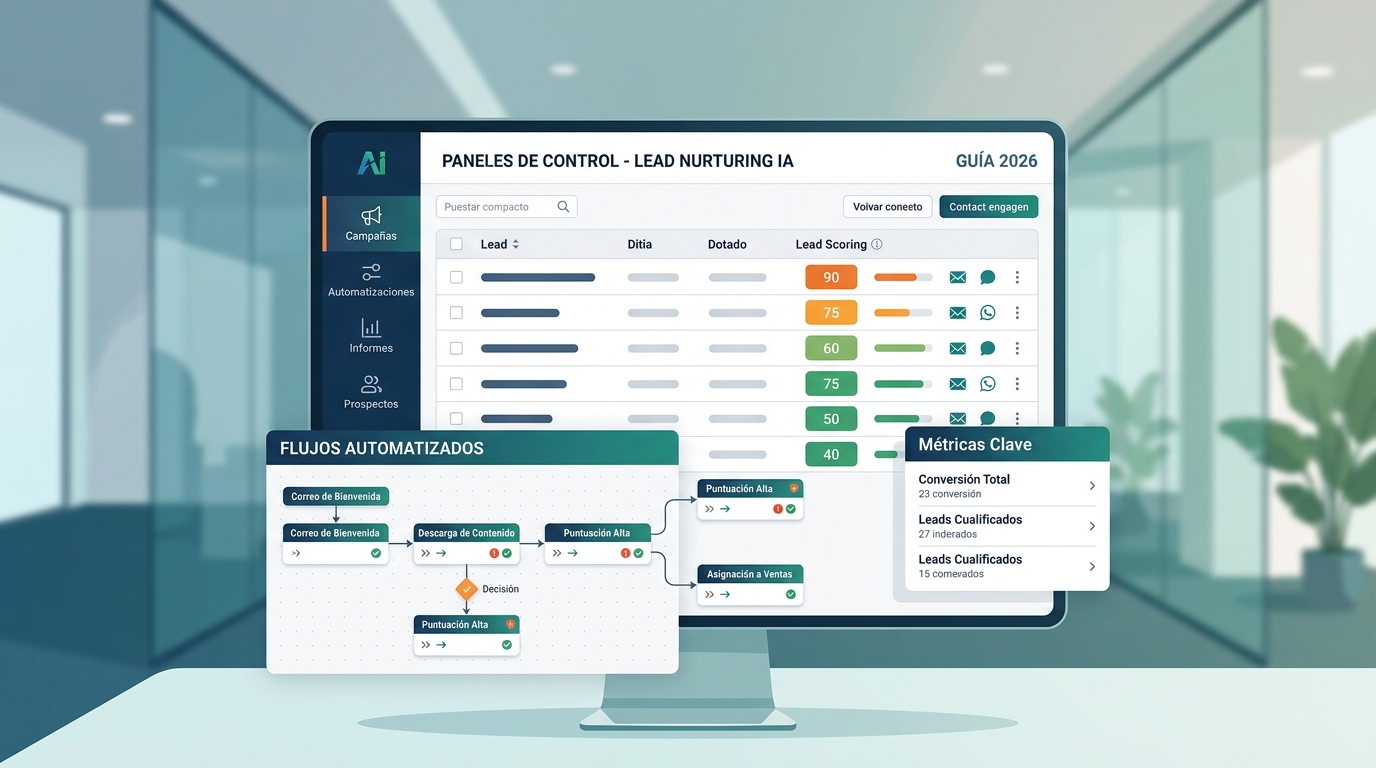
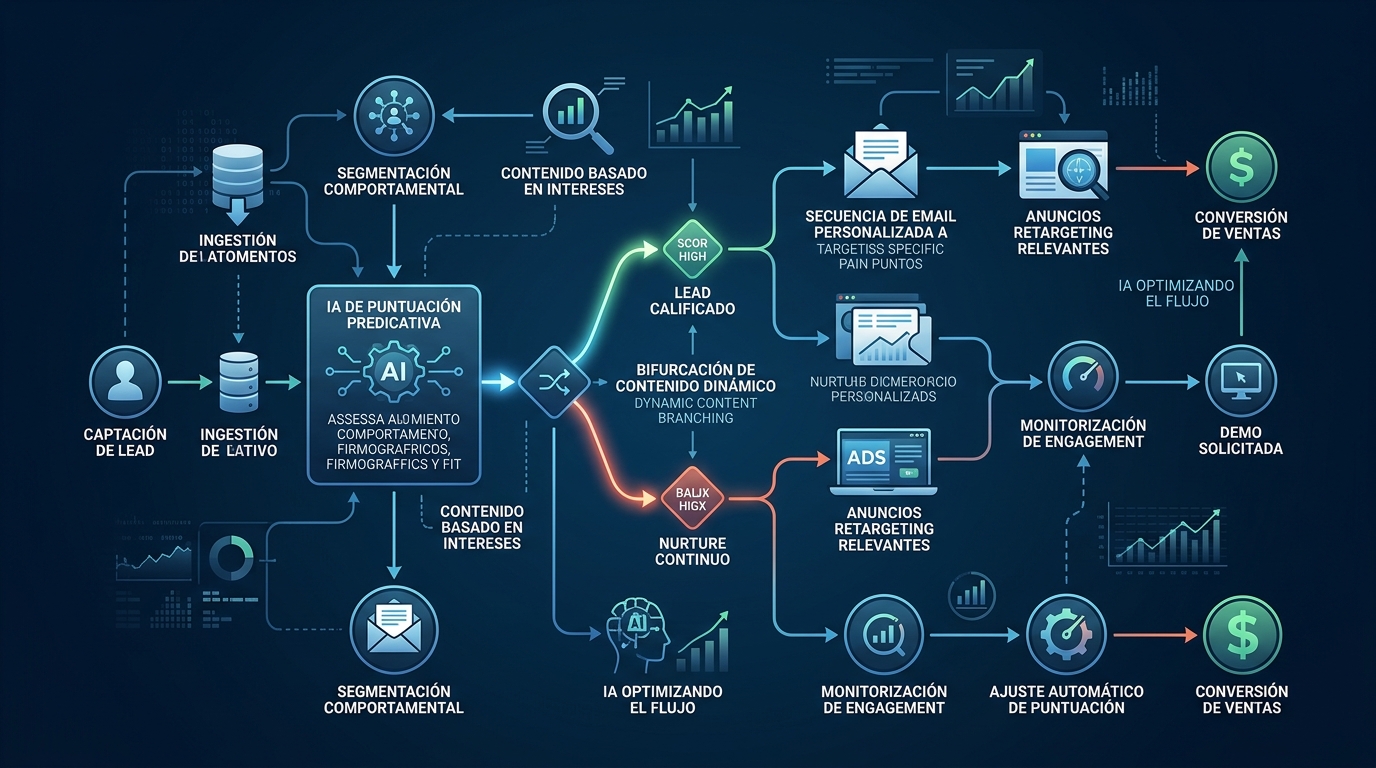
An AI-based lead nurturing platform combines three technological layers to operate: the data layer, the decision layer, and the execution layer. The data layer collects lead behavioural signals from multiple sources (web, email, CRM, social media, forms). The decision layer applies machine learning models to predict the next optimal action. The execution layer launches that action on the corresponding channel, be it email, SMS, push notification, retargeting ad, or a task assigned to the sales rep. This cycle repeats in real-time or with a latency of minutes, depending on the platform's architecture.
The data layer is the foundation of everything. Without quality data, AI models produce irrelevant recommendations.
That's why mature platforms integrate native connectors with the most widely used CRMs (Salesforce, HubSpot, Pipedrive), with web analytics tools, and with advertising platforms.
The more signal sources the model has, the more accurate the lead profile will be, and the more precise the next action.
The predictive lead scoring engine
Predictive lead scoring is the central function of the decision layer. Instead of manually assigning points based on fixed rules (opening an email adds 5 points, visiting the pricing page adds 20 points), the predictive model learns from leads that converted in the past and extracts behavioural patterns. These patterns are then applied to current leads to estimate each one's conversion probability.
This approach has an immediate practical advantage: the sales team knows which leads to focus their energy on this week. They don't work with a list ordered by subjective criteria, but with a classification based on real historical behaviour.
When scoring is accurate, effective contact rates increase because the sales rep calls those who are genuinely considering a purchase, not just someone who downloaded an ebook three weeks ago.
Dynamic content personalisation
Beyond timing, dynamic content personalisation allows two leads receiving the same email to see different messages based on their industry, their stage in the conversion funnel, or their previous behaviour. The most advanced platforms use conditional content blocks that are assembled at the time of sending. A lead from the financial sector sees a use case from their industry; a lead from the retail sector sees another. The email subject line can vary based on the recipient's open history.
This capability, which previously required complex manual segmentation and multiple versions of each campaign, is now managed with rules configured once and executed automatically at scale.
What key components should the platform have?
A well-designed AI-powered nurturing platform isn't just a simple email campaign manager with an added chatbot. It has a specific functional architecture that should be reviewed before making any purchase decision. The essential components are as follows, and the absence of any of them is often the root cause of nurturing projects that fail to take off.
The first component is bidirectional integration with the CRM. The platform must read data from the CRM to enrich the lead profile and, at the same time, write the interaction history and updated score back to the CRM. If synchronisation is unidirectional or manual, the sales team will be working with outdated information.
Multichannel flow management
Modern nurturing doesn't just happen in email. Leads interact with a brand via LinkedIn, Google Ads, website chat, WhatsApp Business, and phone calls. A platform that only manages automated email is operating with a partial view of the journey. Multichannel flow management allows you to orchestrate all these touchpoints from a single place, preventing the lead from receiving contradictory or redundant messages across different channels.
This means the platform must have connectors with the main advertising tools (Meta Ads, Google Ads, LinkedIn Campaign Manager) to suppress audiences of already converted leads or to activate retargeting ads when a lead visits the pricing page without having completed the contact form.
Attribution analytics and reporting
The third critical component is attribution analytics. Knowing which nurturing actions have truly contributed to closing an opportunity is the unresolved problem for many marketing teams. AI-powered platforms can apply multi-touch attribution models that distribute credit across all touchpoints in the journey, not just the first or last. This gives the marketing team a more honest picture of the return on each action and allows for more robust investment decisions.
What are the differences between traditional nurturing and AI-powered nurturing?
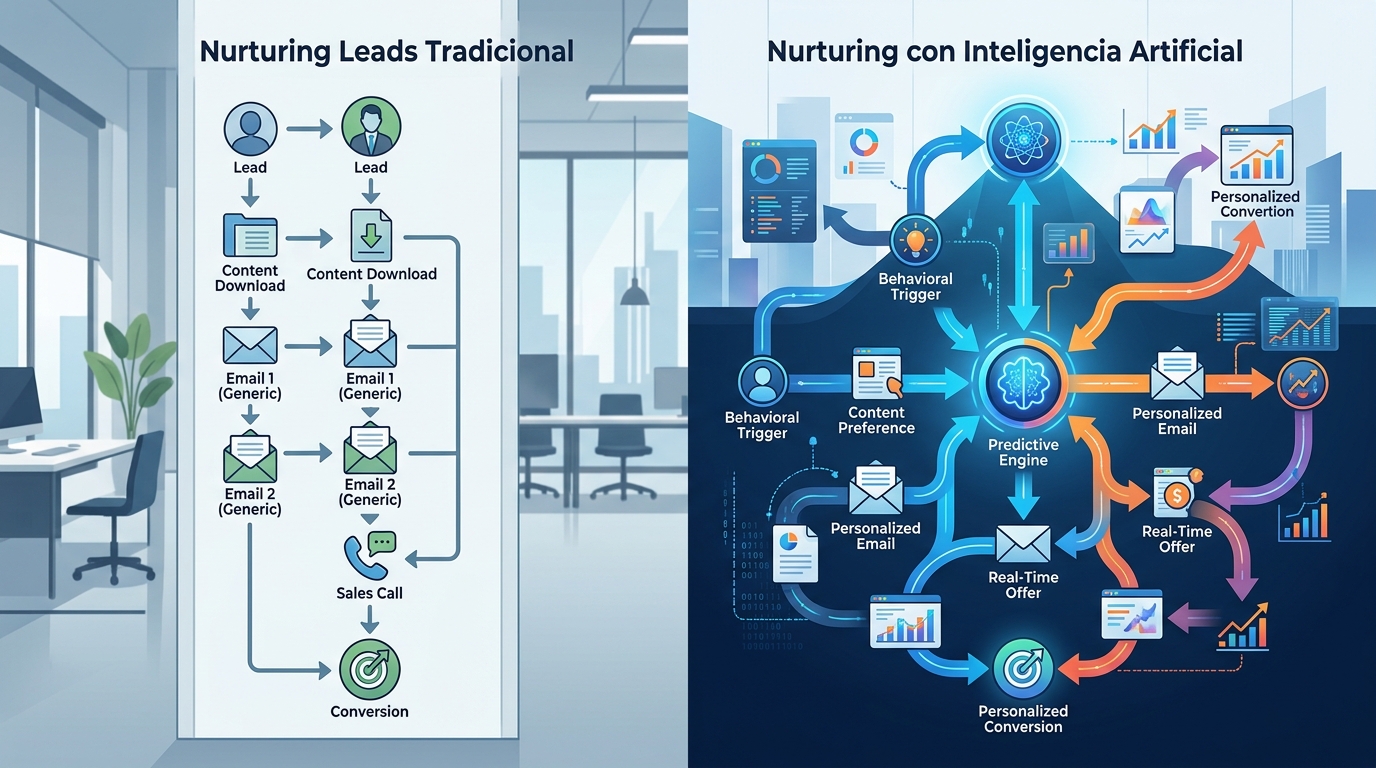
Traditional nurturing operates with sequential and deterministic logic: the lead enters a predefined sequence and follows the steps in the established order, regardless of their actual behaviour. AI-powered nurturing operates with probabilistic and adaptive logic: each decision is made based on the lead's current state and what historical data suggests as the best next action. The practical difference translates into significantly different engagement rates when the volume of leads exceeds levels that a team can manage manually.
Traditional nurturing has its advantages: it's predictable, easy to audit, and doesn't require large volumes of historical data to function. For early-stage companies with few leads per month, a well-designed sequence can be sufficient.
The problem arises when volume grows, when sales cycles are long and complex, or when leads come from multiple sources with very different profiles.
When AI makes a real difference
Artificial intelligence in nurturing provides differential value in three specific scenarios. First, when the volume of leads exceeds the capacity for manual segmentation (generally from several thousand active leads in the conversion funnel). Second, when the sales cycle is long (more than 30 days) and the lead needs multiple touchpoints across different channels to progress. Third, when the content catalogue is extensive, and manually choosing which piece to send to each profile consumes too much team time.
Outside these scenarios, adding AI can generate complexity without a proportional return. Not every company needs the most sophisticated platform on the market. The key is to calibrate the level of automation with the actual volume and complexity of the sales process.
What criteria should be considered when choosing the right platform?
Choosing an AI-powered lead nurturing platform is a decision that affects marketing and sales processes for years, not months. Therefore, it's advisable to evaluate with objective criteria and not be swayed solely by demos or the number of features in the catalogue. The criteria that truly matter in 2026 are the following, ordered by their impact on the final outcome.
The first criterion is the quality of integrations with your current tech stack. An excellent platform that doesn't integrate well with your CRM or web analytics tool will generate data silos and operational friction from the first month. Before evaluating any AI functionality, ensure that integration with the tools you already use is native, bidirectional, and stable.
Ease of use for the marketing team
The second criterion is usability for the marketing team. AI-powered nurturing platforms have a learning curve. If configuring a flow requires technical team intervention every time the marketing team wants to make a change, agility is lost. Evaluate whether flows can be created and modified from a no-code visual interface, whether scoring rules are editable by the marketing team, and whether the platform offers proven flow templates to get started from scratch.
Transparency of the AI model
The third criterion, and the most overlooked, is the transparency of the AI model. Some platforms present AI as a black box: the system decides but doesn't explain why. This is a problem when the team needs to justify decisions or wants to learn from the model's behaviour to improve their strategy. Prefer platforms that explain, at least in summary, which variables carry the most weight in scoring and what patterns the model has detected in your lead database.
Other relevant criteria include the pricing model (whether it scales reasonably with contact volume), support and onboarding time, and GDPR compliance, especially regarding the storage and processing of data for European citizens.
What are the most common mistakes when implementing AI-powered nurturing?
The most common mistakes when implementing an AI-powered automated nurturing platform are not technical, but strategic. The first and most common is feeding the system with poor quality data. If the contact database has duplicates, empty fields, or outdated data, the AI model produces irrelevant recommendations from day one. Before activating any automation, it's essential to clean and enrich the database.
The second mistake is not aligning qualification criteria between marketing and sales before configuring scoring.
If the sales and marketing teams don't have the same criteria for what's a sales-qualified lead (SQL), the system might be sending high-scoring leads that the sales team systematically rejects, which generates friction and distrust in the tool.
The third mistake is launching too many flows at the same time. Nurturing automation allows you to create flows for every imaginable scenario, but managing them all at once without sufficient data to optimise them generates noise and fatigue in the contact database. The most effective approach is to start with two or three critical flows (welcome, education, reactivation), measure their performance for at least 60 days, and then expand.
The fourth mistake is not regularly reviewing active flows. AI models are not static; lead behaviour changes, the market changes, and content becomes obsolete.
Without regular reviews, the system might be sending content that's no longer relevant or using scoring signals that have lost their predictive capability.

How to measure the performance of automated nurturing?
Measuring the performance of an AI-powered lead nurturing strategy requires going beyond email metrics (open rate, click-through rate) and connecting nurturing actions with actual commercial results. First-level metrics (opens, clicks) indicate whether content is relevant, but say nothing about the impact on the sales workflow.
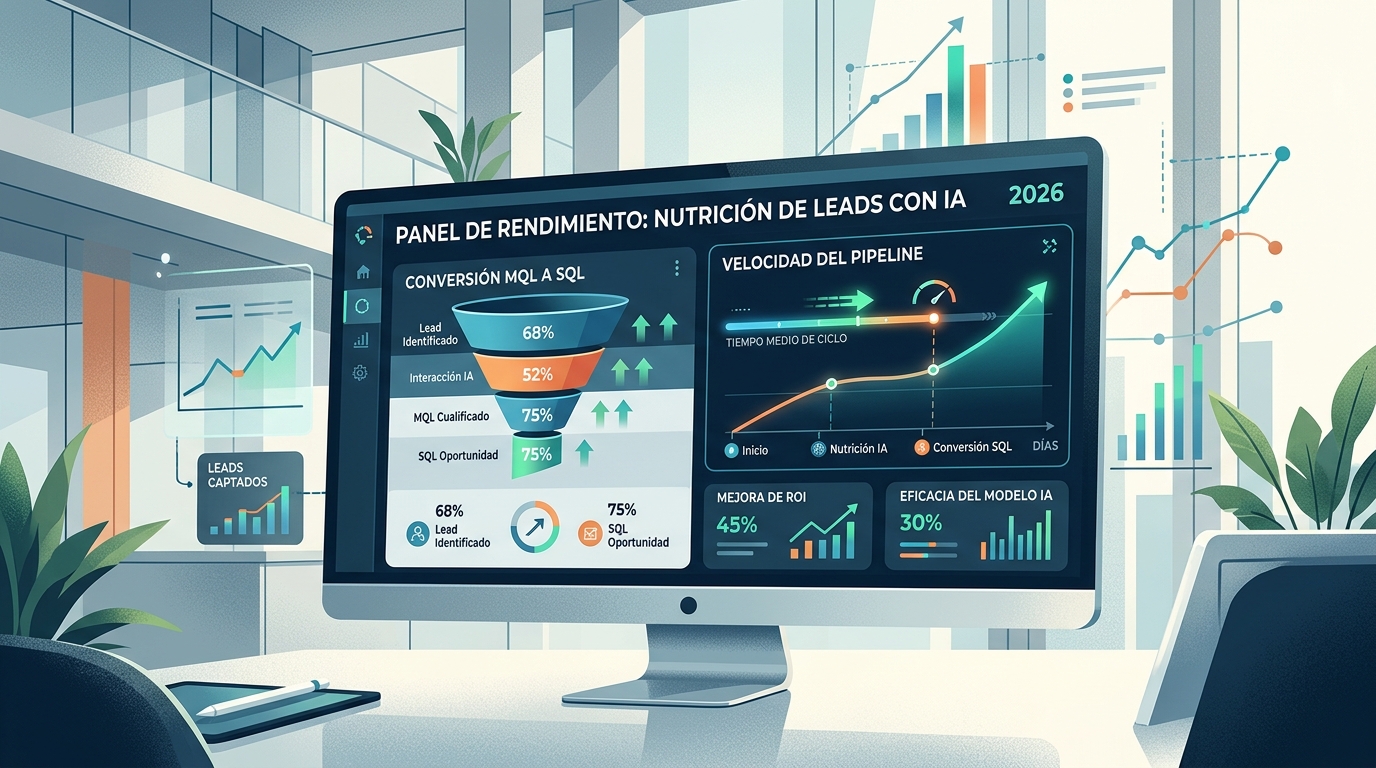
The metrics that truly matter are the following. The MQL to SQL conversion rate measures how many marketing-qualified leads are ultimately accepted by sales as genuine opportunities.
If this rate is low, the problem usually lies in the scoring criteria or the quality of the flow's content. Workflow velocity measures how long it takes a lead to advance from one stage to the next.
An effective nurturing platform should reduce this time in stages where the lead needs information before speaking with a sales rep.
Key metrics specific to AI-powered nurturing
The key metrics specific to automated nurturing include the percentage of leads that move out of an inactive state after a reactivation campaign (reactivation rate), the cost per qualified opportunity generated by nurturing versus other sources, and the percentage of closed opportunities where nurturing was a recorded touchpoint.
This last metric requires the platform to have multi-touch attribution capability and for the CRM to record the nurturing interaction history.
Without that record, it's impossible to demonstrate the value of nurturing in the sales cycle and, consequently, difficult to justify the investment to management.
A recommended practice is to establish a control group: a small percentage of leads that don't receive automated nurturing and serve as a benchmark for comparing conversion rates. This experiment, though simple, provides a direct measure of the platform's impact.
Frequently Asked Questions
How many leads do I need for an AI-powered nurturing platform to be profitable? There's no universal threshold, but most specialised platforms start to show a clear return when the active volume in the conversion funnel exceeds 1,000-2,000 leads per month and the sales cycle lasts more than two weeks.
Does AI in nurturing replace the sales team? No. AI automates informational support and initial qualification, but closing complex B2B sales still requires human intervention. The value lies in the sales rep receiving better-prepared leads and spending less time on cold prospects.
How long does it take to implement an AI-powered nurturing platform? It depends on the complexity of the tech stack and the state of the database. A basic onboarding with two or three active flows can be achieved in four to six weeks. Complex projects with multiple integrations and custom scoring may require three to four months.
Is AI nurturing GDPR compliant? European platforms or those with European compliance certifications must comply with GDPR. It is the company's responsibility to correctly configure consent, data retention, and the right to be forgotten. Always verify that the chosen platform allows you to manage these aspects from the administration panel.
Can I use AI nurturing if I sell to individuals (B2C) and not just businesses? Yes. Although most documented use cases are B2B, AI-powered nurturing platforms work equally well in B2C, especially in sectors with long decision cycles such as education, personal finance, or real estate.
What happens to leads that don't respond to any nurturing flow? Mature platforms include specific reactivation flows for inactive leads and, at a certain point, allow for automatic archiving of contacts that haven't interacted within a defined period, keeping the database clean and licence costs under control.
