Summary: A marketing automation platform with integrated landing pages centralises lead generation, segmentation, and tracking in a single environment. This eliminates friction between tools and reduces the time from the first click to conversion, making it the operational core of any B2B or B2C digital marketing strategy.
What is a marketing automation platform with landing pages
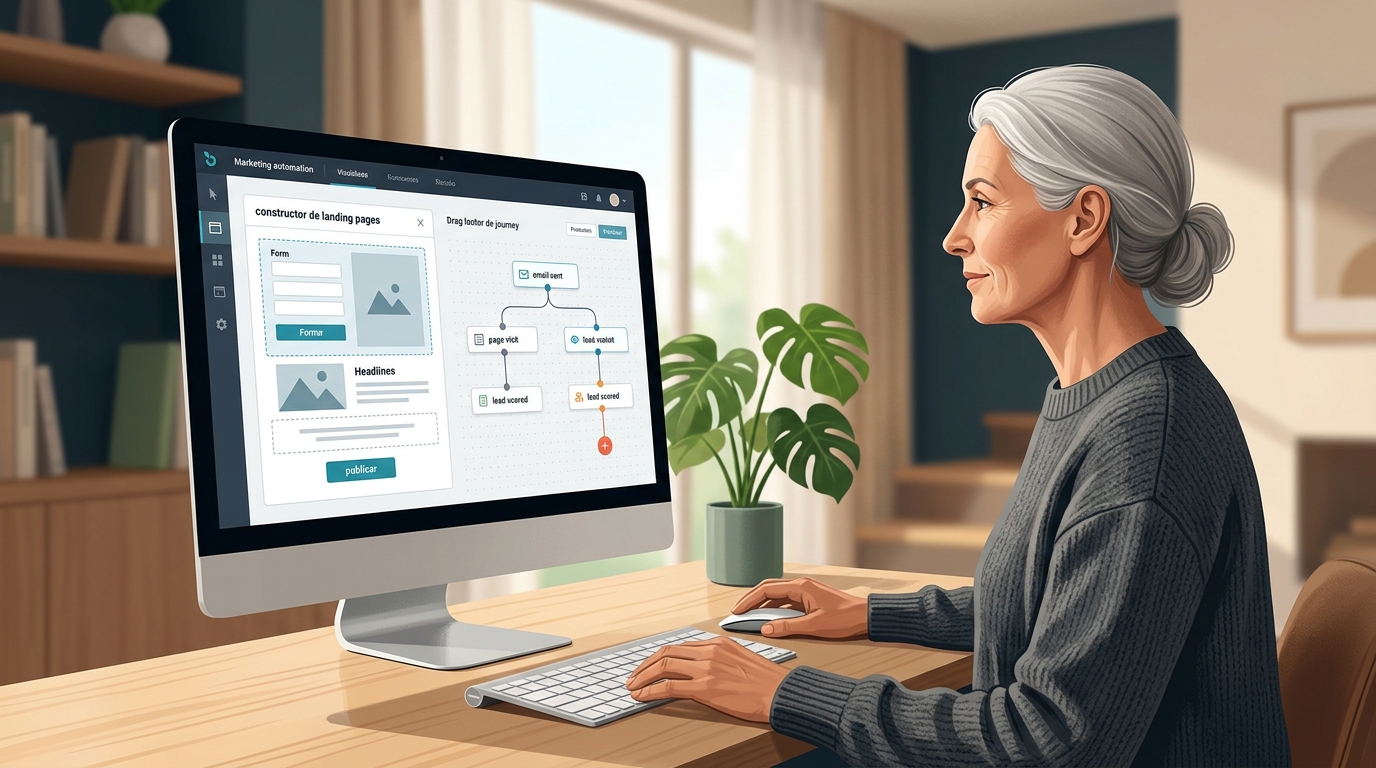
A platform for marketing automation for small business with landing pages is a software system that combines, in a single environment, the creation of lead-generation-focused landing pages with the automation of communication flows triggered after each conversion. According to HubSpot Research data published in 2024, companies that align lead generation with nurturing automation achieve conversion rates between 30% and 50% higher than those managing both processes with separate tools. The key is that data captured on the landing page immediately feeds email, SMS, or push notification flows without the need for manual exports or intermediate integrations.
In the Spanish and European markets, the adoption of these types of platforms grew steadily between 2022 and 2025, driven by the need for centralised GDPR compliance and the pressure to reduce cost per lead. Boomatik responds to this context by offering a unified environment where the marketing team can design the landing page, configure the lead capture form, define segmentation tags, and launch the automation sequence from the same dashboard.
The practical result is that a lead's lifecycle is tracked from the first click on an ad to the sales close, with all touchpoints recorded.
This not only improves the team's operational efficiency but also provides the necessary data to make optimisation decisions based on real insights.
The difference compared to a traditional automation platform without a page builder is substantial: when the landing page lives outside the automation system, context is lost.
You don't know which version of the page the user saw, which elements triggered conversion, or which traffic came from which campaign. By unifying both modules, that information becomes available to the segmentation engine.
Why native integration matters more than API connection
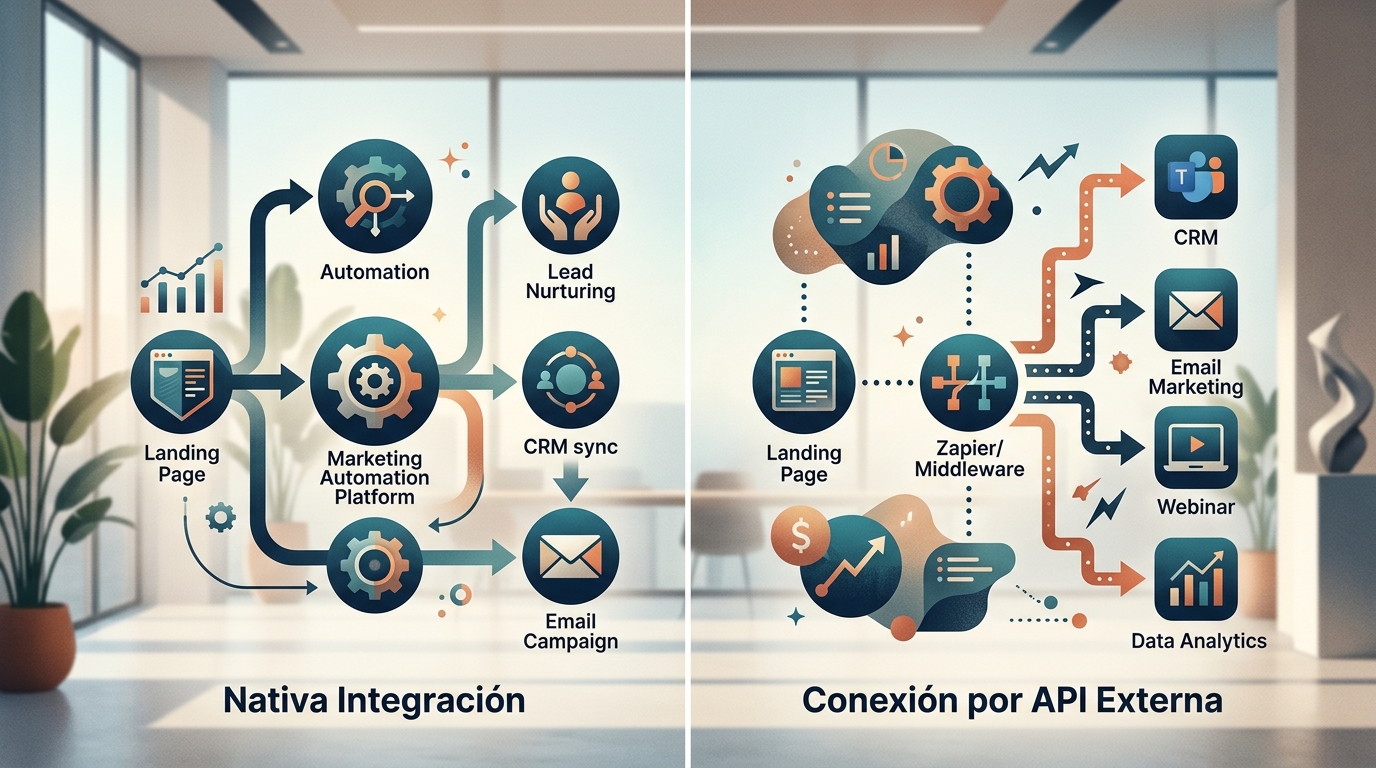
Native integration between the landing page builder and the automation engine eliminates data latency, synchronisation errors, and reliance on third-party tools like Zapier or Make to connect systems that should speak the same language from the outset. When a lead fills out a form on a native landing page, the system can activate a welcome flow in less than a second, assign an initial lead scoring value, and tag the contact based on the traffic source, all without human intervention. This isn't possible with the same reliability when the landing page is hosted on an external tool connected via webhook.
Teams working with fragmented stacks — a landing page builder on one side, a platform for email marketing on the other, and an independent CRM — often encounter three recurring problems: time lags in sequence activation, loss of original campaign attribution, and duplicate contacts in the database. Each of these problems has a direct cost on the open rate of welcome emails, which is the highest in the entire cycle and has the greatest impact on long-term deliverability.
Native integration also simplifies technical maintenance. When the platform updates its automation engine, the connector with the page builder updates simultaneously.
With third-party API integrations, any change in the API version can break the flow for hours or days without the marketing team immediately detecting it.
From a GDPR compliance perspective, native centralisation also offers clear advantages.
The record of consent, the date, and the specific form where it was obtained are stored in the same system that manages mailings, which facilitates auditing and responding to data subject rights requests.
What key features should the platform have?
Not all platforms that include landing pages and automation offer the same level of integration or capabilities. Identifying critical features before evaluating options saves weeks of testing and avoids switching tools after six months.
Landing page builder with dynamic variables
A mature landing page builder in 2026 isn't limited to dragging and dropping content blocks. It must allow dynamic content personalisation based on traffic source, contact segment, or conversion funnel stage. If a user arrives from a retargeting campaign, the landing page should display a different message than what someone arriving from organic search sees. This capability, known as dynamic content on landing pages, multiplies message relevance without needing to create dozens of different URLs.
The builder must also generate pages with mobile-optimised loading times.
According to Google's Core Web Vitals report from 2025, pages with a Largest Contentful Paint exceeding 2.5 seconds lose between 20% and 40% of visitors before the form even appears on screen.
A platform that doesn't address this technical aspect will limit your campaign performance regardless of copy quality.
Behaviour-based automation flows
Behaviour-based automation is a qualitative leap from classic time-based sequences. Instead of sending email 2 three days after email 1, the system reacts to what the contact does: if they open the email but don't click, they receive a different variant; if they visit the pricing page twice, they enter a sales follow-up branch. This conditional logic transforms the nurturing sequence into an adaptive process.
For this to work, the platform needs a web behaviour tracker that records visits to specific site pages, not just email interactions.
This is where native integration makes a difference again: if the landing page lives within the same platform, user behaviour on it directly feeds the flow conditions.
Integrated lead scoring
Lead scoring assigns points to each contact based on their demographic characteristics and behaviour. A comprehensive platform allows you to define automatic scoring rules — add 10 points for opening an email, 25 for visiting the pricing page, subtract 15 for 30 days of inactivity — and set alert thresholds for the sales team. When a lead reaches the threshold score, the system can notify the assigned salesperson, create a task in the CRM, or move them to a closing sequence.
Conversion analytics per landing page and per flow
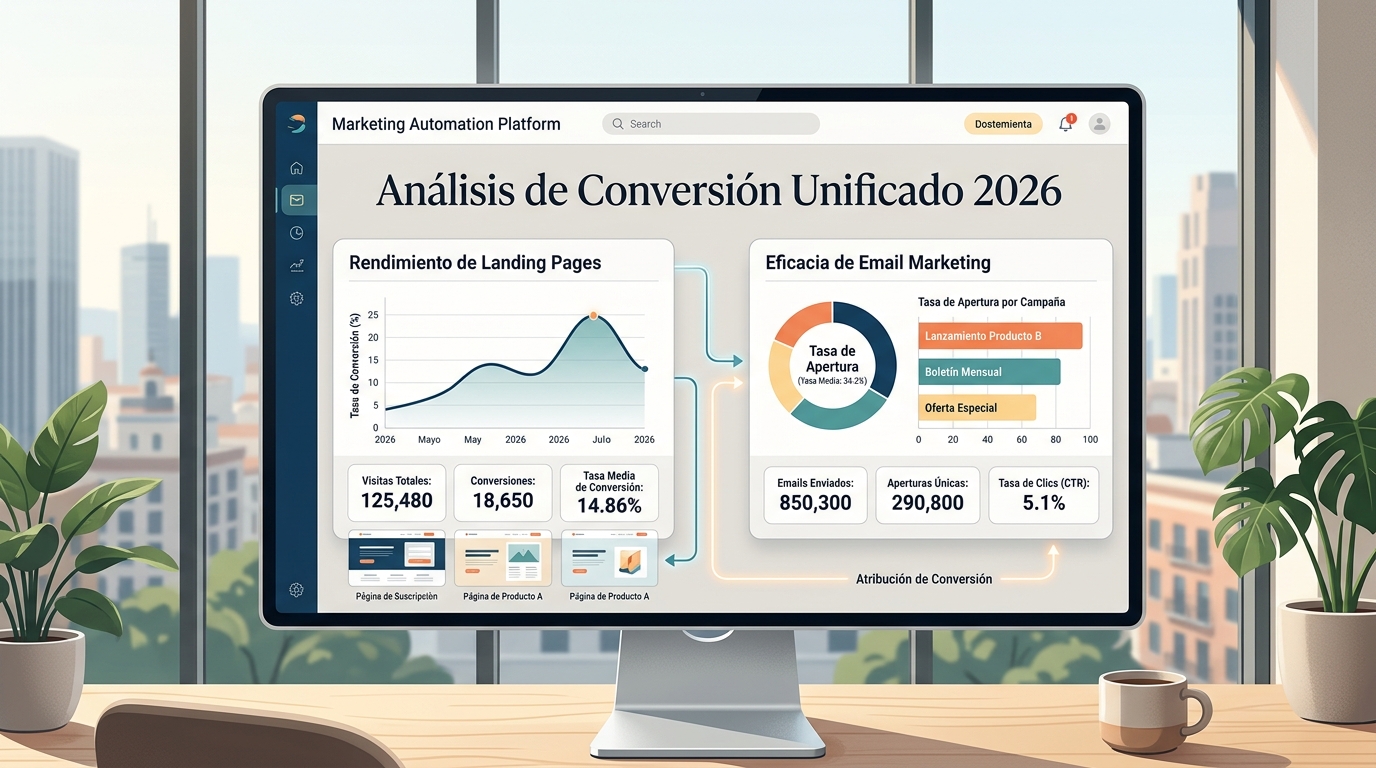
Analytics cannot be a separate module. The platform must display in the same dashboard the conversion rate of each landing page, the open and click-through rate of each email in the flow, and the percentage of leads advancing from one stage to the next.
Without this unified view, optimisation becomes a guessing game.
How to build a conversion funnel with automated landing pages?
Building a conversion funnel with automated landing pages first requires defining the buyer's journey stages and then mapping which landing page and automation sequence correspond to each stage. Without that prior map, the result is a collection of disconnected pages and emails that don't guide the lead towards any clear objective.
The basic structure of a functional conversion funnel has four stages: attraction, capture, nurturing, and conversion. Each stage has a specific landing page with a concrete objective and an associated automation flow.
Capture stage: the entry landing page
The entry landing page has a single objective: to get the visitor to leave their data in exchange for something they perceive as valuable. That something could be a downloadable resource, a demo, a discount, or simply relevant information.
The form should request the minimum necessary fields for initial segmentation: name, email, and, if the business requires it, company or company size.
When the user submits the form, the system must simultaneously activate two things: the sending of the confirmation email or delivery of the promised resource, and the assignment of segmentation tags based on the traffic source and the offer content.
These tags will determine which branch of the nurturing flow the contact receives.
Nurturing stage: educational and activation sequences
The automated nurturing sequence aims to move the lead from initial interest to purchase intent. This is achieved by sending relevant content at the right time: first educational content that reinforces the problem the product solves, then specific use cases, followed by testimonials or social proof, and finally a direct value proposition.
The duration and frequency of the sequence depend on the buying cycle. In B2B with long cycles, a sequence of 8-12 emails over 3-4 weeks is reasonable. In B2C with quick decisions, 3-5 emails in 5-7 days may be sufficient.
The platform must allow these parameters to be adjusted without needing to rebuild the entire sequence.
Conversion stage: the offer landing page and closing flow
The conversion landing page is where the specific offer is presented: price, features, guarantees, and the main call to action. This page should only receive leads who have completed nurturing or have shown high intent signals (repeated visits, clicks on pricing emails, high lead scoring). Sending cold traffic directly to this page is one of the most common and costly mistakes in paid campaigns.
The closing flow includes automated reminders for those who visit the page but don't convert, and notifications to the sales team for the highest-scoring leads.
How to choose the right marketing automation platform in 2026?
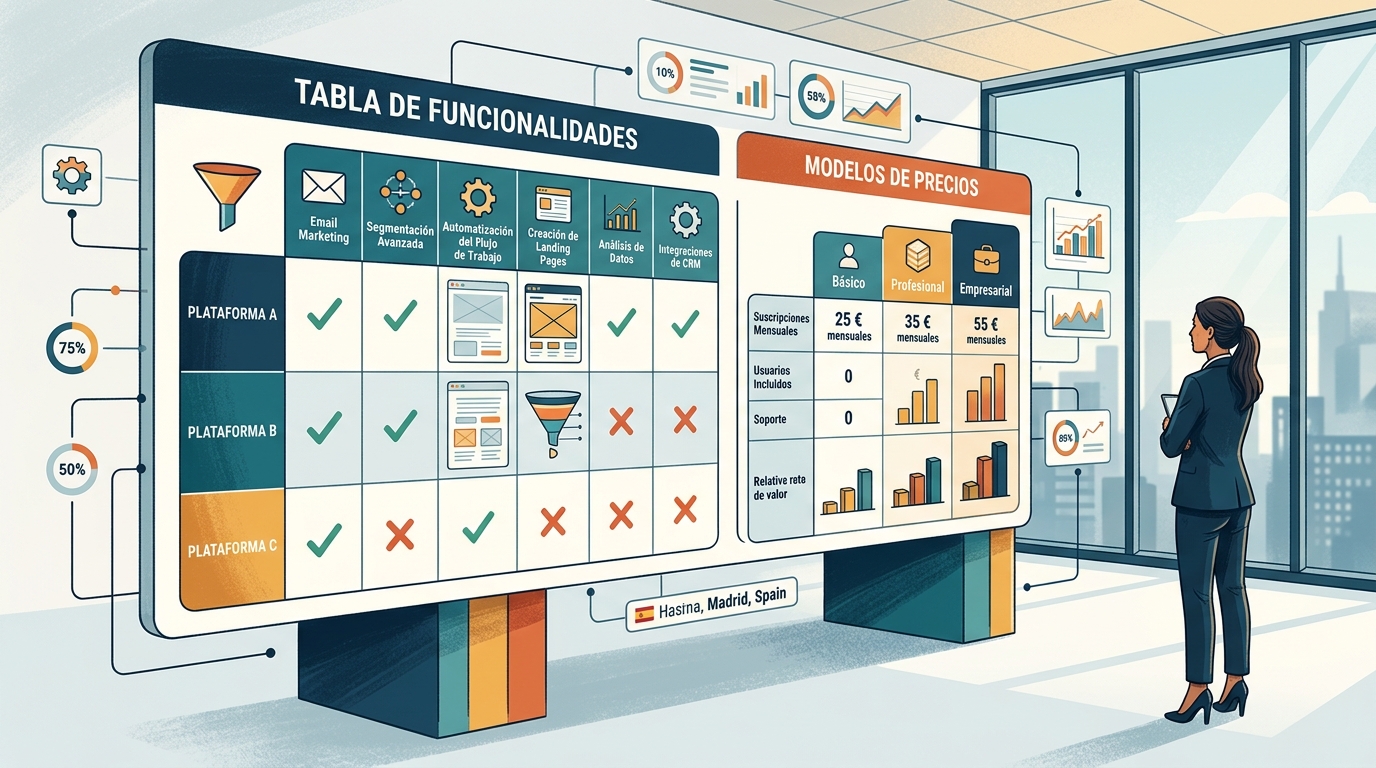
Choosing a marketing automation platform isn't just a technical decision. It's a strategic decision that affects your team's execution speed, cost per lead, and the quality of data available for decision-making. In 2026, the market offers options ranging from all-in-one platforms to specialised solutions that require integrations to complete the stack.
Evaluate the real learning curve, not the demo video's
The learning curve for a complex platform can consume weeks of team productivity. Before signing a contract, request access to a trial period with your real business data, not the pre-loaded sample data.
Check how long it takes someone without a technical background to build a functional landing page and launch a basic three-email flow.
If that process requires more than a day's work, the platform has usability friction that will impact the team's execution speed.
Verify email deliverability quality
A platform might have the best landing page builder on the market, but if its sending IPs have a damaged reputation, your emails will end up in the spam folder.
Ask the provider for their average deliverability metrics (inbox placement rate) and check if they offer dedicated sending domains, guided IP warming, and pre-configured SPF, DKIM, and DMARC authentication.
Confirm GDPR compliance and data location
For companies operating in Spain or the European Union, GDPR compliance is not optional. The platform must process and store data on servers within the European Economic Area or under valid international transfer mechanisms. Request the Data Processing Agreement (DPA) before contracting and verify that the provider has an updated record of processing activities.
Price per contact versus price per send
The pricing model for automation platforms varies significantly. Some charge by the number of active contacts in the database, others by sending volume, and others by unlocked features.
For large databases with low sending frequency, the per-send model might be more economical. For small databases with high communication frequency, the per-contact model might be better.
Calculate the total annual cost across three growth scenarios for your database before committing.
What are the most common mistakes when implementing marketing automation with landing pages?
The implementation of a marketing automation platform with landing pages fails more often due to strategic errors than technical limitations. Knowing the most common mistakes before starting can save months of work and budget invested in the wrong direction.
Launching flows before validating the landing page
Activating an automation sequence on a landing page that isn't converting is one of the most costly mistakes. If the landing page has a 1% conversion rate when your industry benchmark is 3-5%, the problem lies with the page, not the flow.
Before investing time in building elaborate nurturing sequences, validate that the landing page converts with real traffic. An A/B test with the headline and call to action can double the conversion rate in two weeks.
Segmenting late instead of at the source
Segmentation should start at the lead capture form, not afterwards.
If you capture all leads in the same list without differentiating the source, product of interest, or buyer profile, the nurturing flow will have to be generic for everyone, which reduces its effectiveness.
Adding a hidden field to the form that records the origin campaign or downloaded content is technically trivial and has a huge impact on subsequent personalisation.
Ignoring periodic contact database hygiene
A contact database with 20-30% inactive or incorrect addresses damages the sending domain's reputation and reduces the deliverability of all mailings, including those to active contacts. Database hygiene should be an automated process: removing contacts who haven't opened any emails for more than six months from active lists and running a reactivation campaign before permanently deleting them.
Not connecting automation data with the sales team
Marketing automation loses half its value if lead behaviour data doesn't reach the sales team at the right time. Integration with the CRM, or at least automated notifications to the assigned salesperson when a lead reaches the scoring threshold, is the bridge that converts automation into real revenue. Without that bridge, hot leads cool down while waiting for someone to contact them.

What is a marketing automation platform with landing pages?
It's an online program or service that allows businesses to create web pages designed to capture contacts and, at the same time, automatically manage subsequent communications with those contacts. Instead of using separate tools for each task, everything is centralised: page design, data collection forms, sending follow-up emails, and audience segmentation based on their behaviour. This reduces manual work and allows for consistent communication with potential customers from the moment they show interest.
What's the average cost of a marketing automation platform in 2026?
Prices vary widely depending on the number of contacts and included features. Basic options start from around 15 to 30 euros per month for small databases, up to 1,000 or 2,000 contacts. Mid-range solutions, with advanced automations and unlimited landing pages, typically cost 80 to 200 euros per month. Platforms designed for large enterprises can exceed 500 euros per month. It's advisable to compare not only the initial price but also the costs per additional contact and the features that are locked in the more economical plans.
What's the difference between a landing page and a normal website page?
A normal website page usually has a navigation menu, various sections, and links to other parts of the site. Its objective is to inform about the company in general. A landing page, on the other hand, is designed with a single, specific purpose: to get the visitor to perform a particular action, such as leaving their email address, requesting information, or downloading a document. That's why it eliminates distractions, has no menu, and concentrates all content on convincing the visitor to take that specific step. This makes it much more effective for specific campaigns.
Do I need technical knowledge to use these platforms?
Most current platforms are designed for anyone to use without needing to code. They include visual drag-and-drop editors, pre-designed templates, and step-by-step wizards for configuring automated mailings. Even so, getting the most out of them requires dedicating time to understanding the logic of automations and reviewing results periodically. For businesses with very specific needs or integrations with other management software, occasional technical support can be useful, though it's not essential to get started.
Frequently Asked Questions
How long does it take to implement a marketing automation platform with landing pages? A basic implementation with a functional landing page and a three-email welcome flow can be operational within a week. A full implementation with multiple conversion funnels, lead scoring, and CRM connection requires between four and eight weeks, depending on the business's complexity and the team's resources.
Is a technical team needed to manage the platform? Modern marketing automation platforms with visual landing page builders are designed for marketing teams to manage without development expertise. For advanced integrations with CRM or external systems, occasional technical support may be necessary.
What's the difference between a landing page within the automation platform and a main website page? The main difference is functional: the landing page within the platform is directly connected to automation flows and feeds the contact database in real-time. A main website page requires additional integrations to achieve the same result and usually has more navigation elements that distract the visitor from the conversion goal.
Do marketing automation platforms with landing pages comply with GDPR? Platforms that process data of European citizens must comply with GDPR. Verify that the provider offers a DPA, stores data in the EEA, and allows consent and data subject rights to be managed from the dashboard itself.
How many emails should a basic nurturing sequence have? A basic B2B nurturing sequence usually has between five and eight emails spread over two to three weeks. In B2C with short decision cycles, three to five emails in five to seven days may be sufficient. The most important thing is that each email has a specific objective and a single call to action.
What metrics should I track to know if the conversion funnel is working? The priority metrics are: landing page conversion rate, open and click-through rate of each email in the flow, progression rate between conversion funnel stages, and cost per qualified lead. With these four metrics, you have enough information to identify bottlenecks and prioritise optimisations.
