Summary: A certified Odoo partner in Spain specialising in marketing automation connects the CRM, the email marketing, lead management, and campaigns within a single ERP system. Choosing the right partner makes the difference between an implementation that works from the first month and one that's abandoned after six months.
What an Odoo Partner Is and Why Marketing Specialisation Matters
A Odoo partner in Spain is a company certified by Odoo S.A. to implement, customise, and support the most widely used open-source ERP in the European SME market. According to Odoo's official directory, there are over 5,000 active partners worldwide, several dozen of whom operate from Spain. Certification requires passing official technical exams and maintaining a minimum number of active implementations per year, ensuring a proven level of competence. However, the certification level (Ready, Silver, Gold) doesn't indicate functional specialisation, and here's the key point: a generalist partner can implement accounting or inventory without issue, but marketing automation in Odoo requires specific knowledge of nurturing flows, contact segmentation, integration with digital channels, and conversion metrics.
Specialisation matters because Odoo's Marketing module isn't just an email sender. It integrates the CRM database, allows for building automation flows conditioned by lead behaviour, connects with social media and manages events, web forms, and landing pages within the same environment. A partner who doesn't regularly work with these modules makes costly configuration errors: duplicates in the contact database, overlapping automation flows, or metrics disconnected from the sales workflow.
In the Spanish market, demand for marketing-oriented Odoo implementations has grown visibly over the last three years, driven by companies looking to consolidate disparate tools (HubSpot, Mailchimp, Salesforce, spreadsheets) into a single system.
Odoo's competitive advantage in this context is its modular architecture: you only pay for the modules you use, and everything shares the same database, eliminating third-party integrations and associated costs.

Specialisation in marketing automation for small business with Odoo also involves understanding the Spanish regulatory context. The General Data Protection Regulation (GDPR) and the Organic Law on Data Protection (LOPDGDD) establish specific obligations regarding consent for commercial communications. A well-trained partner configures lead capture forms, double opt-ins, and consent records directly in Odoo, ensuring the marketing database complies with regulations from the outset.
How Marketing Automation Works in Odoo
Marketing automation in Odoo is primarily structured through the Marketing Automation module, available since Odoo 13 and significantly improved in versions 16 and 17. This module allows for building workflows based on triggers and conditions: when a contact opens an email, visits a page, downloads a document, or meets a condition in their CRM record, the system automatically executes the next defined action. These actions can include sending an email, assigning a task to a salesperson, changing the lead's status in the workflow, or adding the contact to a new segmentation list. Everything happens without manual intervention and in real-time, within the same environment where the sales team works on their CRM.
The basic automation flow in Odoo follows this logic: first, the starting audience is defined (a segment of contacts filtered by CRM criteria: industry, job title, workflow stage, purchase history).
Then, the sequence of activities is built with its branching conditions: if the contact opened the email, they go down path A; if they didn't open it within 48 hours, they go down path B. Each node can include a temporary wait, an additional condition, or a direct action.
Native Integrations That Boost Automation
Odoo Marketing Automation natively integrates with other ERP modules that set it apart from independent marketing tools:
- Odoo CRM: leads generated by campaigns are created directly in the sales team's workflow, with full traceability from the first interaction.
- Odoo Email Marketing: manages lists, templates, mass mailings, and open/click metrics from the same platform.
- Odoo Website and Forms: embedded website forms send data directly to CRM and Marketing, without third-party integrations.
- Odoo Events: allows nurturing event attendees with automated sequences before and after the event.
- Odoo SMS Marketing: combines email and SMS in the same automation flow.
Integrated Metrics and Reporting
One of the strengths of the Odoo marketing module is that campaign reporting doesn't reside in an external tool. Open rates, clicks, unsubscribes, and conversion metrics are linked to the contact in their CRM record, so the sales team sees the complete interaction history before calling a lead. This eliminates the usual gap between marketing data and sales context.
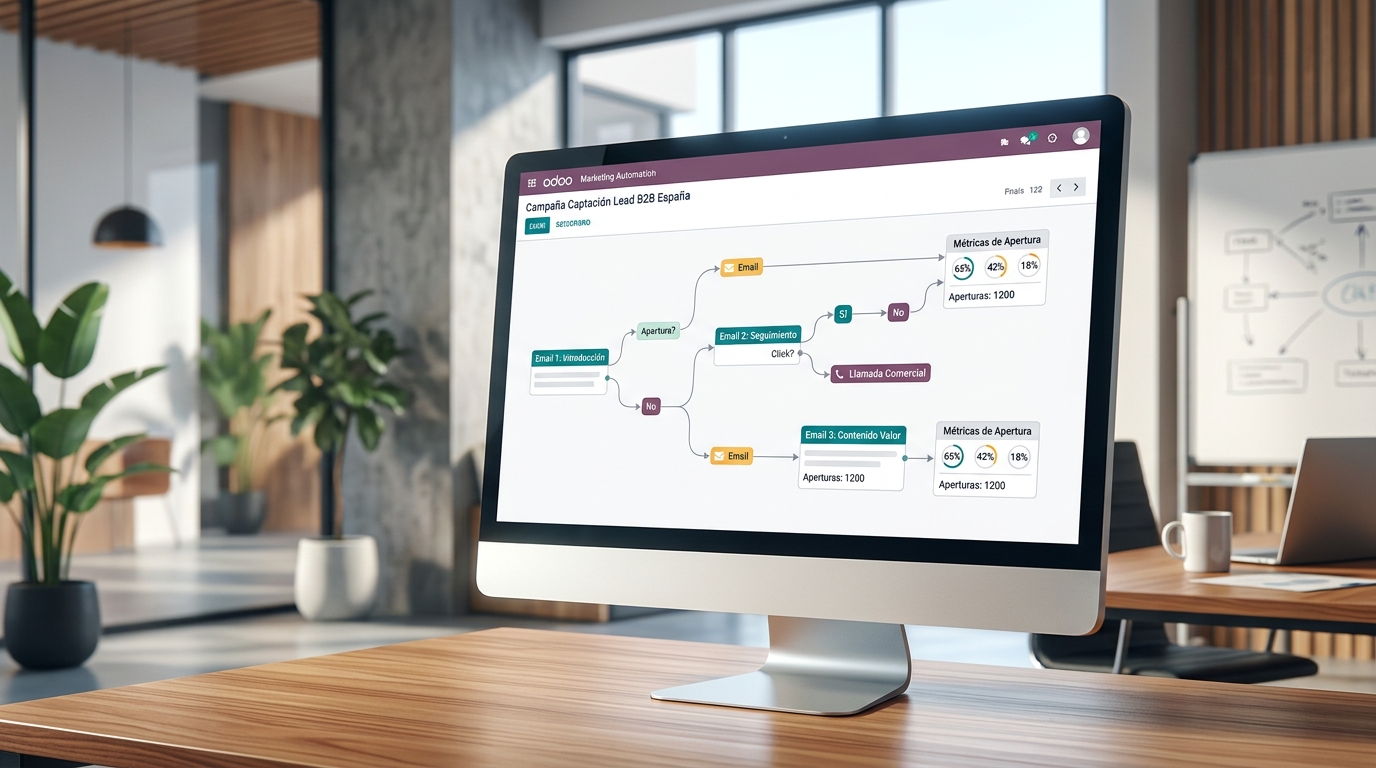
Reporting configuration requires the Odoo partner to have correctly mapped conversion objectives from the outset. An automation flow without a defined key destination metric generates data that no one looks at.
That's why the pre-implementation consulting phase is so relevant: it's not just about installing modules, but about designing flows based on the client's commercial objectives.
Which Odoo Modules Do Marketing Departments in Spain Use Most?
Marketing departments in Spanish companies working with Odoo don't use a single module, but a combination that varies by sector and operational volume. The most common modules in digital marketing with Odoo implementations in the Spanish market are the following, based on experience working with clients in the sector:
Email Marketing
It's the entry module for most teams. It allows managing distribution lists, creating templates with a visual editor, scheduling sends, and checking basic metrics (open rate, clicks, unsubscribes).
Version 17 includes improvements in blacklist management and bounce handling, critical aspects for maintaining the sender domain's reputation.
The email deliverability rate depends not only on the server's technical configuration (SPF, DKIM, and DMARC records) but also on the quality of the database. An Odoo partner with marketing experience configures these technical records and designs a database hygiene process from the initial implementation.
Marketing Automation
It's the flagship module for teams wanting to go beyond mass mailing. It allows building nurturing sequences with behaviour-based conditions: opens, clicks, website visits, changes in CRM stage.
The learning curve is moderate, but without good initial configuration, flows generate noise and audience fatigue.
CRM
Odoo CRM isn't strictly a marketing module, but it's the central axis of any automation strategy. The quality of contact segmentation for campaigns directly depends on how the CRM is structured and populated. A partner who implements marketing without reviewing the client's CRM status makes a fundamental error.
Website and Forms
Odoo includes a website builder that natively integrates with CRM and Marketing. Lead capture forms send data directly to the correct contact lists, without third-party plugins or Zapier integrations.
For companies looking to simplify their tech stack, this integration is one of the strongest arguments in favour of Odoo.
SMS Marketing and WhatsApp Business
Since Odoo 16, the SMS Marketing module allows text messages to be included in automation flows.
Integration with WhatsApp Business via the official API is available through community modules or certified partners, and it's one of the most demanded integrations in the Spanish market, where WhatsApp has very high penetration.

What Differentiates a Good Odoo Marketing Partner from the Rest
An Odoo partner specialising in marketing in Spain differs from a generalist in several specific aspects that should be evaluated before signing an implementation contract. It's not a matter of company size or number of certifications; it's a matter of methodology and project history.
The first indicator is whether the partner has documented use cases in marketing automation projects.
It's not enough for them to just install the module; they must have designed real nurturing flows for clients with active databases, resolved deliverability issues, and integrated marketing reporting with the sales workflow.
If the partner cannot demonstrate such a project, the client becomes the testing ground.
The second indicator is the pre-consultancy methodology. Before installing anything, a partner experienced in B2B or B2C marketing automation dedicates time to mapping the client's lead capture and nurturing flows, auditing the quality of the existing database, and defining the key metrics the system needs to measure. This phase can last between two and four weeks depending on complexity, but it's what determines whether the implementation delivers real value.
Red Flags in an Odoo Marketing Partner
- Proposes implementing the Marketing Automation module without first auditing the client's CRM.
- Doesn't mention the configuration of technical email records (SPF, DKIM, DMARC) in the project scope.
- Doesn't have a defined training process for the client's marketing team.
- Offers a budget significantly below market rates without justifying the reduced scope.
- Cannot show metrics from previous Odoo marketing automation projects.
What a Good Implementation Project Should Include
- Contact database audit and cleansing plan.
- Design of automation flows before technical configuration.
- Technical configuration for email deliverability.
- Integration of web forms with CRM and marketing lists.
- Specific training for the marketing team, not just the technical team.
- System documentation delivered to the client.
- Post-implementation support plan with defined SLA.
What is the Odoo Marketing Automation Implementation Process Like?
A well-executed marketing automation in Odoo implementation follows a structured process, typically lasting between 6 and 16 weeks depending on client complexity. Implementations that are rushed without respecting the consulting and validation phases generate rework that increases the final project cost.
Phase 1: Analysis and Design (Weeks 1-3)
In this phase, the partner reviews the client's current situation: what marketing tools they use, how many contacts are in their database, how the lead capture and nurturing process is structured, and what metrics are relevant to the business.
The result is a functional design document that describes the automation flows, audience segments, key metrics, and the necessary module architecture.
This phase also includes the GDPR audit of the database: verifying that contacts have recorded consent and that the lead capture process complies with current regulations. In Spain, the Spanish Data Protection Agency (AEPD) has published specific guides on data processing in digital marketing that the partner must be familiar with.
Phase 2: Configuration and Integration (Weeks 4-9)
The partner's technical team configures the modules according to the approved functional design.
This includes environment installation, module configuration, data migration from previous tools, technical email configuration (SPF, DKIM, DMARC in the client's DNS), and the construction of the initial automation flows.
The migration of contact data to Odoo is one of the most delicate phases. Errors in field mapping or duplicate cleansing can compromise campaign quality from day one. An experienced partner dedicates specific time to this task and validates imported data before activating any flows.
Phase 3: Training and Testing (Weeks 10-13)
Before go-live, the client's marketing team receives practical training on the system. This isn't a demo; these are working sessions where the team learns to create segments, design flows, interpret metrics, and manage unsubscribes.
In parallel, automation flows are tested with real test data to verify that conditions and actions function correctly.

Phase 4: Go-live and Support (Weeks 14-16 onwards)
The production launch is planned with a controlled time window. The partner must be available during the first few weeks of live operation to resolve incidents and adjust configurations.
The post-implementation support contract must define response times for critical incidents (stopped automation flow, mass sending errors) and for non-urgent queries.
What Criteria Should You Evaluate When Choosing Your Odoo Partner in Spain?
The Odoo partner ecosystem in Spain offers very different options in terms of size, specialisation, and service model. Choosing well requires evaluating specific, not generic, criteria. These are the factors that carry the most weight in the decision for marketing automation projects:
Certification Level and Odoo Version
Odoo certifies its partners at Ready, Silver, and Gold levels based on the number of active clients and technical exams passed.
For marketing automation projects of a certain complexity, it's advisable to work with Silver or Gold partners who have certified experience with the most recent versions (Odoo 16 or Odoo 17 in 2026).
Older versions have functional limitations in the marketing modules that can affect the project.
Functional Specialisation in Marketing
Not all Odoo partners work with marketing modules to the same depth. Some specialise in accounting and finance, others in manufacturing or logistics. For a digital marketing automation project, look for a partner who can demonstrate specific projects in that area, with examples of designed nurturing flows, migrated databases, and improved campaign metrics.
Ability to Integrate with External Tools
Although Odoo natively covers most marketing needs, some clients require integrations with external tools: Google Analytics 4, Meta Ads, e-commerce platforms like Prestashop or Shopify, or legacy ERPs. The partner should have experience with these integrations and be able to clearly quote for them.
Support and Continuity Model
Post-implementation support is just as crucial as the implementation itself. Marketing automation systems require ongoing maintenance: Odoo version updates, workflow adjustments when client strategy changes, and resolution of technical issues.
Evaluate the partner's support model, guaranteed response times, and the stability of the team assigned to your project.
References and documented case studies
Ask for references from the partner's real clients on Odoo marketing projects. A 20-minute chat with a previous client will give you more insight than any sales presentation.
Specifically enquire about the quality of the initial consultation, adherence to deadlines, and the standard of post-implementation support.

Boomatik operates as Odoo partner in Spain, focusing on projects that combine ERP and digital marketing. If you'd like to explore how an Odoo implementation geared towards marketing automation can benefit you, you can check out the services available at boomatik.com.
Frequently Asked Questions
How much does a marketing automation implementation with Odoo cost in Spain? The cost depends on the number of modules, the complexity of the automation workflows, and the volume of data to be migrated. Without specific project details, it's impossible to provide an exact figure, but average-scope projects in the Spanish market typically include several weeks of consulting, configuration, training, and initial support.
Does Odoo replace Mailchimp or HubSpot? Odoo Marketing can replace Mailchimp for most mass email marketing and basic automation use cases. For advanced HubSpot functionalities (predictive lead scoring, native integrations with certain ad platforms), Odoo requires additional modules or integrations. The decision depends on your current tech stack and specific client requirements.
Is double opt-in mandatory in Odoo to comply with GDPR in Spain? Double opt-in isn't strictly mandatory under GDPR, but it's the recommended practice for demonstrating explicit consent. Odoo includes double opt-in functionality in its forms for subscription, and configuring it correctly is part of the scope of a well-executed marketing project.
Which Odoo version is most recommended for marketing in 2026? Odoo 17 is the latest version with active support in 2026 and offers the most significant improvements in marketing modules, including better blacklist management, enhanced reporting, and improved integration with the Website module. Odoo 16 remains a valid option for clients who already have it implemented.
Can an Odoo partner migrate my contacts from HubSpot or Salesforce? Yes, migrating contacts and CRM data from HubSpot, Salesforce or any platform that exports in CSV or via API is a common task in implementation projects. The quality of the migration depends on prior data cleansing and the correct mapping of fields between the two platforms.
How long does it take for an Odoo marketing automation system to become operational? A standard-scope project, with an already clean contact database and not overly complex automation workflows, can be operational within 8 to 12 weeks from the project's start. Projects involving complex data migrations or integrations with multiple external systems will require more time.
What exactly does an Odoo partner specialising in marketing automation do?
An Odoo certified marketing automation partner configures and customises the email, contact segmentation, scheduled sends, and campaign tracking modules within the Odoo system itself. Their work includes analysing the company's business processes, designing automated communication flows, integrating Odoo with other tools if necessary, and training the internal team to manage actions autonomously. Unlike a generic implementer, this profile has in-depth knowledge of Odoo's marketing functionalities and can tailor them according to the industry and company size.
How much does it cost to hire an Odoo partner for marketing automation in Spain?
The cost varies depending on the project scope. A basic implementation with email template configuration, contact lists, and automated sends can range from 2,000 to 5,000 euros. More complex projects, involving integrations, advanced workflows, and extended training, can exceed 10,000 euros. On top of this, you'll need to factor in the Odoo licence, which depends on the number of users and the chosen plan. Requesting several quotes from certified partners in Spain and comparing the detailed services included is the most reliable way to align expenditure with actual needs.
Is it necessary to have Odoo already implemented to contract marketing automation services?
It's not essential, though it does simplify the process. If your company already uses Odoo for sales management or invoicing, adding the marketing module takes less time and cost because customer and product data are already in the system. If starting from scratch, the partner can implement Odoo fully or just the marketing modules, depending on your needs. In any case, a prior analysis of existing data is advisable, as migrating contacts from other platforms requires cleansing and structuring before activating any automation.
How do you choose a good Odoo partner for marketing in Spain in 2026?
The first criterion is to verify that the partner is officially certified by Odoo and appears in the public partner directory. Then, it's advisable to review previous projects in companies within the same sector and ask for direct references. It's important to check that the team includes individuals with specific experience in marketing modules, not just accounting or inventory. Post-sales support should also be evaluated: a good partner offers ongoing assistance after launch. Finally, geographical location might be relevant if you prefer in-person attention, although many Spanish partners work remotely without issues.
