Creating your company's brand identity means defining who you are, what you promise, and how you consistently showcase it in everything you do. This guide takes you step-by-step — purpose, name, logo, colours, typography, and tone of voice — with a clear method for an SME. And you'll see how an AI agent can generate that entire brand kit for you in a short time, without relying on an agency and with a result you can use from day one. This is how ai agents for small business are transforming branding.
Many good businesses go unnoticed for a reason that has nothing to do with the quality of what they do: they don't convey a clear identity. The logo was rushed, the colours change depending on who designs the poster, and the message sounds different on the website, in the shop window, and on social media. The result is a business that appears smaller and less trustworthy than it actually is.
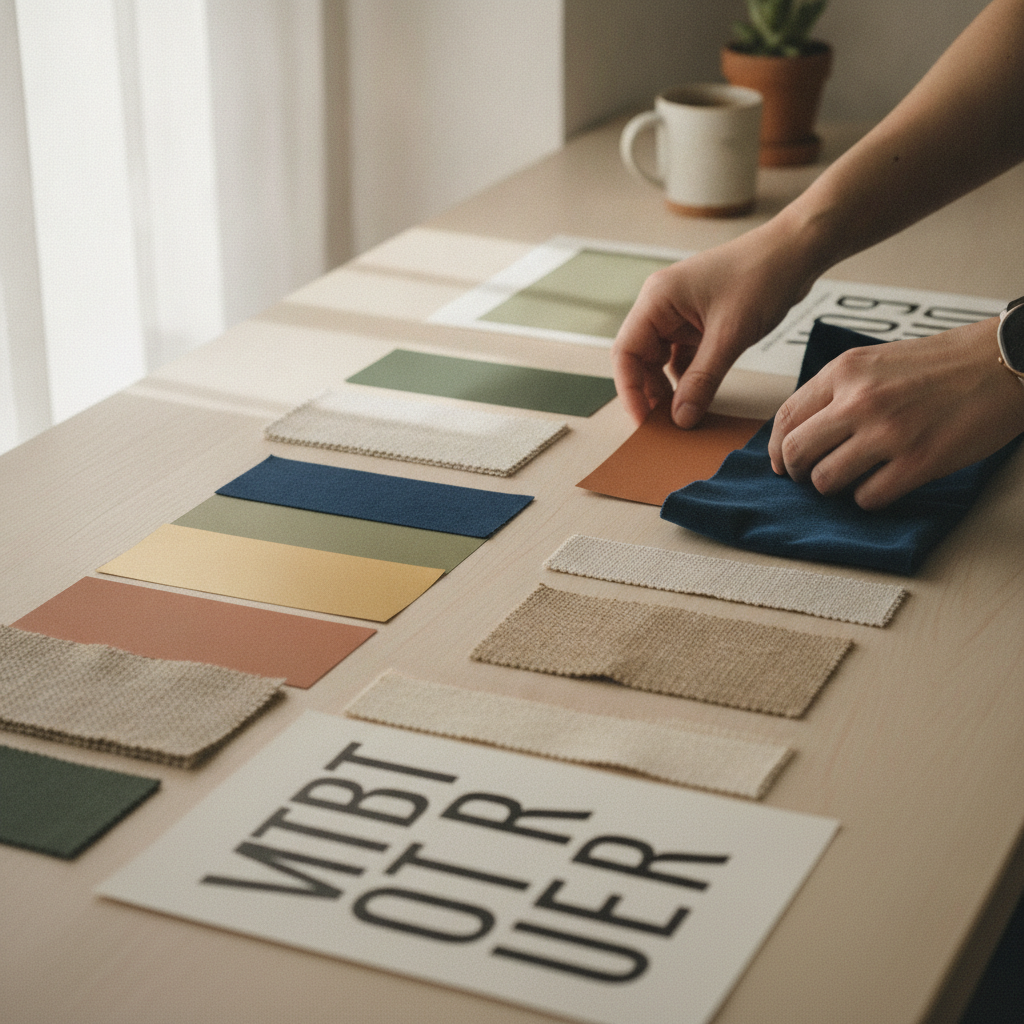
Brand identity is precisely what fixes that. It's not a whim of large companies: it's the tool that makes people recognise you, trust you, and choose you over someone equally good but poorly presented. In this guide, you'll see how to create it step-by-step, and how today you can generate it with artificial intelligence in a fraction of the time and cost it used to take.
What Brand Identity Is (and Isn't)
Brand identity is the set of elements that make your company recognisable and consistent: its purpose, personality, name, logo, colours, typography, and tone of voice. It's the answer to a simple question: when someone encounters your business, what do they perceive and what do they remember?
It's worth dispelling a common misunderstanding. Brand identity isn't just the logo. The logo is the tip of the iceberg. Beneath it lies something more important: what you promise, who you target, what differentiates you, and in what tone you tell your story. A strong brand is the sum of all that applied consistently, not just a pretty symbol placed on top of a rudderless business.
Think of it this way: visual identity is how you're seen, verbal identity is how you sound, and purpose is why you exist. All three must point in the same direction. When they do, your brand is perceived as solid, even if you're a small company.
Why a Strong Brand Identity Sells More
A good identity isn't about aesthetics for aesthetics' sake. It has a direct impact on the business, through several channels simultaneously.
- Builds Trust. A consistent brand appears professional and stable. And people buy from those they perceive as reliable, especially when they don't know you yet.
- Makes You Memorable. Consistent colours, shape, and tone make you memorable. If you appear different every time, you start from scratch with each contact.
- Justifies Your Price. A polished presentation communicates quality. Two identical businesses can charge very different prices just based on how they present themselves.
- Simplifies Everything Else. With a defined brand, creating a website, an advert, or a poster is quick and consistent, because you already know what colours, font, and tone to use.
For an SME, where every euro and every hour counts, a clear identity is one of the investments with the best return: it's done once and works in your favour at every touchpoint for years.
Step 1: Define Your Purpose and Personality
Before thinking about colours or logos, pause and answer the essentials. Without this foundation, everything else will be baseless decoration.
Start with three questions: what do you really do and what problem do you solve? Who do you work for and what matters to that person? And what makes you different from others offering the same? With that clear, define your brand's personality as if it were a person. Is it approachable or formal? Bold or calm? Expert or casual? That personality will then guide how everything looks and sounds.
You don't need a thirty-page document. Just have it written in a few clear sentences that anyone on your team can understand and repeat. That's your compass, and you'll return to it whenever you have a brand query.
Step 2: Create Your Verbal Identity (Name, Message, and Tone)
Verbal identity is how your brand sounds. It includes the name, your main phrase — what you promise in one line — and the tone you always use, on the website, in an email, or when responding to a message.
The tone should stem directly from the personality you defined. If your brand is approachable, you speak informally and without jargon; if it's formal, you pay attention to address and precision. The important thing is that it's the same tone everywhere, because that consistency is what makes people recognise and trust you. A brand that is fun one day and distant the next confuses and erodes trust.
Also define your core message: the idea you want to stick in people's minds. It's not a catchy slogan for its own sake, but the clear promise that summarises why you're worthwhile. Once you have it, everything you write afterwards pulls in the same direction.
Step 3: Design Your Visual Identity (Logo, Colours, and Typography)
Now for the part almost everyone associates with «brand». Visual identity translates your personality into something tangible, and it rests on three pillars.

- The Logo. Your main symbol. It should be simple, recognisable, and work large and small, in colour and black and white. An overly elaborate logo ages poorly and is harder to read.
- The Colour Palette. Choose a main colour and two or three supporting ones, and always use them consistently. Colours convey emotions and are among the first things people associate with your brand.
- The Typography. The font also communicates. Choose one or two fonts consistent with your personality and apply them everywhere: website, documents, social media, and signage.
The key is not just choosing well, but compiling it into a small manual — the brand kit — clearly outlining which colours, fonts, and logo versions to use and which not to. That document ensures the brand remains consistent, even if someone else designs for it.
Step 4: Apply Your Brand Consistently Everywhere
A brand identity only works if applied consistently. There's no point in a beautiful kit saved in a folder if every piece then looks different. Consistency is, in fact, the part most brands neglect and what makes the biggest difference.
Review all your touchpoints and ensure they speak the same visual and verbal language: your website, Google Business Profile, social media, emails, invoices, shop window, uniform, and even your email signature. Each of these places is an opportunity to reinforce who you are or to dilute it. When everything is consistent, your brand appears much larger and more solid than its actual size suggests.
How to Create Your Brand Identity with Artificial Intelligence
Until recently, setting all this up meant hiring an agency or a designer, waiting weeks, and paying a sum that many SMEs couldn't afford. That model is now outdated. Today, an artificial intelligence agent can generate your complete brand identity — logo proposals, colour palette, typographies, tone of voice, and a ready-to-use brand kit — in a very short time. This is a game-changer for ai agents for small business.
It's not just a matter of speed. It's a fundamental shift. An agent works based on what you tell it about your business, it doesn't rest, it doesn't charge by the hour, and its cost is a fraction of that of a human team, because the same platform serves many businesses simultaneously. Here, it's important to be clear: we are not an agency; we are an AI agent platform. The difference isn't «cheaper»; it's that the work is done by a system that's available twenty-four hours a day and delivers a result you can see, adjust, and use instantly. This is the power of ai agents for small business.
With BOO Brand you get exactly that: you describe your business, and the agent proposes a consistent brand identity — logo, colours, typography, and tone — compiled into a kit ready to apply to your website, social media, and signage. You retain the judgment and the final say; the agent handles the heavy lifting that previously held you back. This is the benefit of ai agents for small business.
This doesn't mean good taste or your vision are superfluous. On the contrary: you provide what only you know about your business and your customers, and AI converts that vision into a consistently applied brand, without the time or cost of the traditional model. And the result isn't a vague promise, but a concrete kit you have in your hands from day one.
Common Mistakes When Creating a Brand Identity
To make the effort worthwhile, avoid these pitfalls we see time and again in SMEs:
- Starting with the logo. The logo is the consequence, not the starting point. Without clear purpose and personality, any logo is a shot in the dark.
- Copying the competition. Looking like someone else makes you invisible. A brand serves to differentiate you, not to blend in with the rest.
- Changing style constantly. A brand is built through repetition. If you frequently change colours and tone, you'll never become recognisable.
- Not documenting it. Without a written kit, each person applies the brand in their own way, and consistency is lost within weeks.
- Neglecting consistency. Having a good logo and website isn't enough if the other touchpoints go their own way. The brand's strength lies in the overall package.
Create your brand identity with AI in hours, not weeks.
Discover it →Frequently Asked Questions
Where do I start creating my company's brand identity?
With purpose and personality, not the logo. Define what you do, for whom, and what differentiates you. With that foundation, the rest of the decisions — name, colours, tone — will naturally fall into place.
Do I need to hire an agency or a designer?
It's no longer essential. An AI agent can generate a complete brand identity for you based on what you tell it about your business, in a short time and for a fraction of the cost, delivering a ready-to-use kit for you to validate. This is a core benefit of ai agents for small business.
How long does it take to get a brand identity ready?
With the traditional method, weeks. With an AI agent, the initial kit — logo, palette, typography, and tone — is generated in a very short time, and then you just review and refine it to your liking. This is a key advantage of ai agents for small business.
Can I change my brand identity later?
Yes, but wisely. You can evolve it as your business grows; what's damaging is constantly changing style. A brand's strength lies in consistency maintained over time.
Does it work for any type of business?
Yes. Having a clear identity helps any business — a shop, a workshop, a consultancy, or an online business — to be recognised, trusted, and chosen over someone equally good but poorly presented.
Creating your company's brand identity isn't about spending a lot or waiting weeks, but about being clear on who you are and consistently showing it everywhere. You can compare good branding practices in reference resources like Canva, but you no longer have to do the heavy lifting manually. Discover BOO Brand and generate your company's complete brand identity with an AI agent that works for you, providing a powerful tool for ai agents for small business.
