In summary: Google Ads campaigns allow you to appear exactly when someone is searching for what you sell, and you only pay when they click. Well-structured campaigns bring measurable customers; poorly monitored ones will eat through your budget without return. In this guide, you'll discover how they work, the different types available, the mistakes that ruin SMEs, and why today it makes more sense to let AI optimise them tirelessly rather than paying for hours of manual management.
If you run an SME, you've probably heard a thousand times that Google Ads campaigns are the fast track to acquiring customers. And that's only half true. When well-planned, they put you in front of people who are already actively searching for what you offer, with their hand practically in their wallet. Poorly planned, they're a silent haemorrhage: clicks that don't convert, irrelevant keywords, and a budget that evaporates while you're busy running your business.
The difference between these two scenarios isn't down to chance. It's about how the campaign is set up and, crucially, how well it's maintained afterwards. In this guide, we'll explain without any fluff what's Google Ads, how it works internally, which types of campaigns you should be familiar with, and where small businesses often stumble. And finally, you'll see why the old dilemma of 'do it myself or pay an agency' has become outdated.
What Google Ads Campaigns Are and Why They Matter
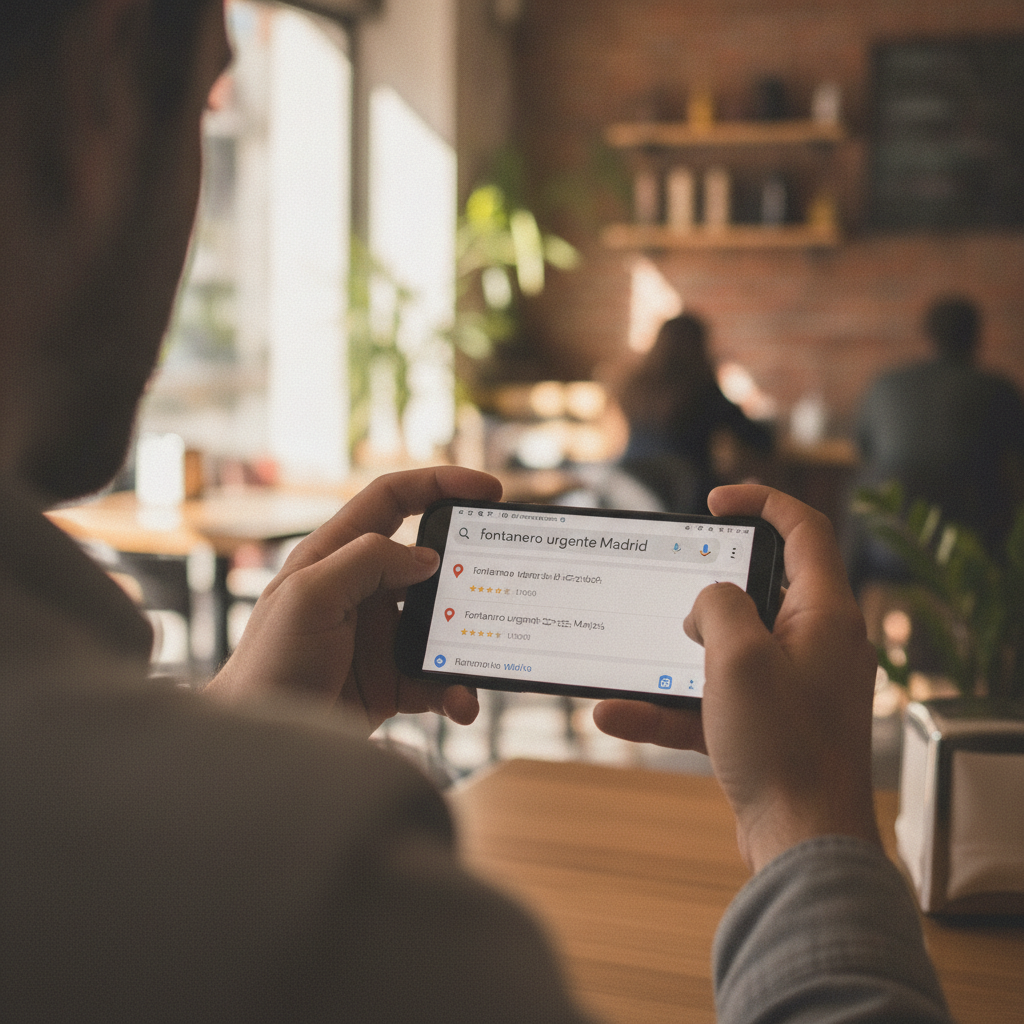
Google Ads is Google's advertising system. The idea is simple: when someone searches for something on Google (for example, 'emergency plumber in Valencia' or 'cheap trail running shoes'), you can pay to appear at the top of the results with an ad. You only pay when that person clicks, not just for the ad to be shown. This is known as cost-per-click (CPC).
The power of this model, and what sets it apart from other channels, is intent. On social media, you interrupt someone who was watching videos; on Google, you appear before someone who is actively searching for a solution. That nuance changes everything: you're not chasing the customer; you're placing yourself exactly where they were already looking for you. For a local or niche SME, it's the most direct way to capture existing demand.
The system operates via an auction. Many advertisers compete to appear for the same searches, and Google decides who shows up and in what order by combining how much you're willing to pay with the quality of your ad and the page you direct the user to. That's why it's not always the highest bidder who wins, but the one who offers the most relevant answer. This is good news for small businesses that do things well.
How the Auction Works Internally (No Jargon)
Imagine Google holding an instant mini-auction every time someone types a search query. In milliseconds, it decides which ads to show and in what position. To do this, it broadly looks at three things: how much you bid, how relevant your ad is to that search, and the experience your landing page offers.
The practical consequence is significant: if your ad and page align well with what the person was searching for, you can pay less and appear higher than a competitor who bids more but is less relevant. Google rewards consistency because it wants happy users. This means quality isn't an aesthetic detail; it's money: a well-constructed campaign performs better with less budget.
The other concept worth understanding clearly is keywords. These are the terms for which you choose to appear. You can bid for broad or very specific searches, and it's equally important to indicate which ones you don't want to appear for (known as negative keywords). For example: if you sell new trainers, you don't want to pay for clicks from people searching for 'free second-hand trainers'. Ignoring this is one of the most common drains on your budget.
Campaign Types Every SME Should Know
Google Ads isn't a single entity. There are various formats, and choosing wisely is half the battle. These are the ones that make the most sense for a small business:
Search campaigns. These are the text ads that appear in search results when someone is looking for something. They are the kings of intent and are often the ideal starting point for capturing those who are already looking to buy or hire.
Display campaigns. Graphic ads that appear on websites, blogs, and apps associated with Google. They are more effective for raising brand awareness and reminding those who have already visited you, rather than for immediate sales.
Shopping campaigns. These display your products with a photo, price, and name directly in the results. If you have an online store, they're almost mandatory because they showcase the product before the click.
Video campaigns. These are the ads you see on YouTube. Very useful for brand awareness, but they demand creativity and aren't the first channel to start with if your goal is direct sales.
Performance Max campaigns. A format that automatically distributes your budget across all Google channels, seeking conversions. They promise simplicity, but they're a somewhat opaque box: if you don't feed them good data and monitor them, it's easy to not understand why they're spending what they are.
For most SMEs, starting with search and adding shopping if you have a store is the most profitable path. Everything else can be added once you have a working foundation.
The Mistakes That Ruin SMEs on Google Ads
This is where the money is lost. Almost all SME failures with Google Ads can be attributed to a handful of repeated mistakes, and none of them have to do with 'not bidding enough'.
The first is to launch and forget. A campaign isn't a poster you hang up and leave. It's a living organism that needs almost daily review: which searches are spending money, which ones are converting, which ads are performing. Without that monitoring, the budget goes down the drain on irrelevant searches.
The second is poor measurement or no measurement at all. If you don't know how many calls, forms, or sales Google Ads brings you, you're spending blindly. Many SMEs look at clicks and believe that's the result. A click is just the beginning; what matters is what happens next on your website.

The third is sending traffic to a weak page. You can have the best ad, but if, upon clicking, the person lands on a slow, confusing page or one without a clear contact button, the money is lost at the final hurdle. The landing page is part of the campaign, not an afterthought.
And the fourth, more fundamental: lack of time. An SME manager doesn't live to monitor dashboards. They log in on Monday, see a number they don't quite understand, and either pause the campaign out of fear or let it run on a prayer. Neither of these is proper management. And hiring someone to do it daily comes with a cost that doesn't always fit a small business budget.
Manage Them Yourself, an Agency, or Tireless AI
For years, there were only two options for Google Ads campaigns: learn to do it yourself and dedicate hours, or pay an agency to do it for you. Both present a problem for an SME. Doing it yourself steals time you should be dedicating to your business. And an agency, beyond quality, operates at a human pace: they review your account periodically, not hourly, and charge you recurring fees for that time.
The problem is that Google Ads never sleeps. The auction changes throughout the day, new searches appear, a competitor raises their bid on a Saturday afternoon. A person cannot be on top of that twenty-four hours a day, nor would it make sense to pay them to try.
That's where artificial intelligence changes the rules. An AI system *can* monitor your campaigns continuously: detecting searches that are spending without converting and cutting them off, reallocating budget to what works, adjusting bids when the auction changes, and notifying you in clear language about what's happening. It doesn't charge by the hour, doesn't go on holiday, and doesn't depend on someone having a slot in their diary. It works while you sleep.
That's exactly what BOO Performance: a platform that plans, creates, and optimises your campaigns automatically and explains it all without jargon, allowing you to decide the objective and budget while the system handles the heavy lifting. It's not a cheaper agency; it's a different model, where you pay for a measurable result that looks after itself, not for a person's time. If you want to delve deeper into that comparison, we explain it in detail in our analysis of advertising agency vs. 24/7 AI.
How to Start Smartly and Without Burning Through Your Budget
If you're going to take the plunge, do it wisely. Firstly, be clear about your objective: wanting phone calls isn't the same as online sales or quote forms. Everything else is ordered from that goal.
Secondly, start small and focused. It's better to begin with a few highly relevant searches and a controlled budget than to open everything up at once. Google needs data to learn, and you need to see what works before scaling. A small, measured start always beats a large, blind one.
Thirdly, mind the destination. Ensure that the page you're sending clicks to loads quickly, clearly states what you offer, and facilitates the next step. There's little point in bringing visitors if they then get lost.
And fourthly, measure what truly matters: how many customers or contacts your investment brings, not just how many clicks. With that data in hand, every decision ceases to be a hunch. Customer acquisition doesn't end with Google Ads: if you want an overall view, take a look at our SEO guide for SMEs to attract customers organically too, and how to set up an email marketing strategy to convert those who already know you from an ad into loyal customers.
If you want to better understand the platform's operation and official policies, Google's own Google Help is a direct reference source. With that foundation, deciding how to manage your campaigns stops being a leap of faith and becomes an informed business decision.
Profitable Advertising on Google and Meta, Managed by AI 24/7.
Discover it →Frequently Asked Questions
How much do Google Ads campaigns cost?
There's no fixed price: you decide the budget and pay per click, so you can start with a modest investment and adjust as you go. What varies greatly is the cost per click depending on your sector and competition, which is why it's sensible to start small and measure the real return before increasing your bid.
Is Google Ads worth it for a small SME?
Yes, especially if you sell something people actively search for, as it puts you in front of customers with purchase intent. The key isn't the size of the business, but planning it well, measuring what converts, and not leaving the campaign unsupervised.
How long does it take to see results?
The first clicks arrive almost immediately, but to know if the campaign is profitable, you need to allow time for it to gather data and learn. Be wary of anyone who promises exact figures beforehand: the sensible approach is to start with a measurable objective and decide based on the results you get.
Do I need an agency to manage Google Ads?
Not necessarily. You can do it yourself if you have the time, hire an agency, or use an AI platform that continuously monitors and optimises campaigns. For an SME, the latter often provides more control and a cost that is a fraction of the agency model.
What's the difference between Google Ads and SEO?
With Google Ads, you pay to appear at the top immediately; with SEO, you work to rank organically in the medium term without paying for each click. They are not mutually exclusive: the ideal is to combine both to capture demand now and build a stable presence simultaneously.
Can I control my campaign if AI manages it?
Yes, and with more transparency than a monthly report. You set the objective, budget, and brand rules, and the system executes and explains each decision on your own dashboard, while the data and account remain yours.
